


Page 282 - IJB-9-6
P. 282
International Journal of Bioprinting                                Progress in bioprinted ear reconstruction


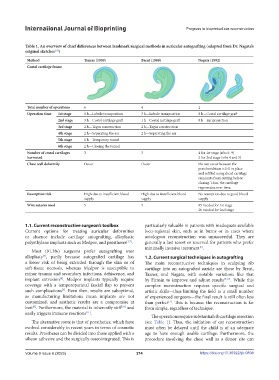
            Table 1. An overview of chief differences between landmark surgical methods in auricular autografting (adapted from Dr. Nagata’s
            original sketches )
                        [13]
             Method                  Tanzer (1959)           Brent (1980)             Nagata (1992)
             Costal cartilage frame


             Total number of operations  6                   4                        2
             Operation time  1st stage  1 h—Lobule transposition  3 h—Lobule transposition  8 h—Costal cartilage graft
                          2nd stage  3 h—Costal cartilage graft  1 h—Costal cartilage graft  8 h—Ear projection
                          3rd stage  2 h—Tagus construction  2 h—Tagus construction
                          4th stage  2 h—Separating the ear  2 h—Separating the ear
                          5th stage  1 h—Temporary tunnel
                          6th stage  2 h—Closing the tunnel
             Number of costal cartilages   3                 3                        4 for 1st stage (ribs 6–9)
             harvested                                                                2 for 2nd stage (ribs 4 and 5)
             Chest wall deformity    Occur                   Occur                    Do not occur because the
                                                                                      perichondrium is left in place
                                                                                      and refilled using diced cartilage
                                                                                      remnants from cutting before
                                                                                      closing. Thus, the cartilage
                                                                                      regenerates over time.
             Resorption risk         High due to insufficient blood   High due to insufficient blood   No resorption due to good blood
                                     supply                  supply                   supply
             Wire sutures used       5                       5                        85 needed for 1st stage
                                                                                      20 needed for 2nd stage


            1.1. Current reconstructive surgeon’s toolbox      particularly valuable in patients with inadequate available
            Current options for treating auricular deformities   loco-regional skin, such as  in burns or  in cases  where
            or absence include cartilage autografting, alloplastic   autologous reconstruction was unsuccessful. They are
            polyethylene implants such as Medpor, and prostheses [3,7] .  generally a last resort or reserved for patients who prefer
                                                               minimally invasive treatment .
                                                                                      [5]
               Most (91.3%) surgeons prefer autografting over
            alloplasty , partly because autografted cartilage has   1.2. Current surgical techniques in autografting
                   [7]
            a lower risk of being extruded through the skin or of   The  main reconstructive  techniques  in  sculpting rib
            soft-tissue necrosis, whereas Medpor is  susceptible  to   cartilage into an autografted auricle are those by Brent,
            minor trauma and secondary infections, dehiscence, and   Tazner, and Nagata, with notable variations like that
            implant extrusion . Medpor implants typically require   by Firmin to improve and adjust results [3,12] . While this
                           [8]
            coverage with a temporoparietal fascial flap to prevent   complex  reconstruction  requires  specific  surgical  and
            such complications . Even then, results are suboptimal,   artistic skills—thus limiting the field to a small number
                           [3]
            as manufacturing limitations mean implants are not   of experienced surgeons—the final result is still often less
            customized, and aesthetic results are a compromise at   than perfect . This is because the reconstruction is far
                                                                         [3]
            best . Furthermore, the material is inherently stiff  and   from simple, regardless of technique.
               [9]
                                                     [10]
            easily triggers immune reactions .
                                      [11]
                                                                  The operations require substantial rib cartilage resection
               The alternative route is that of prosthetics, which have   (see  Table 1). Thus, the initiation of ear reconstruction
            evolved considerably in recent years in terms of cosmetic   must  often  be  delayed  until  the  child  is  of an  adequate
            results. Prostheses can be divided into those applied with a   age to have enough usable cartilage. Furthermore, the
            silicon adhesive and the surgically osseointegrated. This is   procedure involving the chest wall as a donor site can

            Volume 9 Issue 6 (2023)                        274                        https://doi.org/10.36922/ijb.0898

