


Page 412 - IJB-9-6
P. 412
International Journal of Bioprinting                                   Biofabrication for islet transplantation


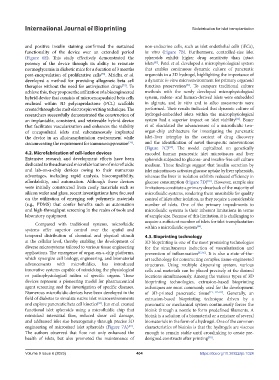
            and positive insulin staining confirmed the sustained   non-endocrine cells, such as islet endothelial cells (iECs),
            functionality of the device over an extended period   in vitro (Figure 7B). Furthermore, controlled-size islet
            (Figure 6E). This study effectively demonstrated the   spheroids exhibit higher drug sensitivity than intact
            potency of the device through its ability to reinstate   islets . Patel et al. developed a microphysiological system
                                                                   [81]
            normoglycemia in diabetic mice for a duration of 3 months   that  enables continuous  dynamic culture  of  pancreatic
            post-encapsulation of proliferative cells . Mridha  et al.   organoids in a 3D hydrogel, highlighting the importance of
                                            [78]
            developed  a  method  for  providing  allogeneic  beta  cell   a dynamic in vitro microenvironment for primary organoid
                                                                                [82]
            therapies without the need for antirejection drugs . To   function  preservation .  To  compare  traditional  culture
                                                     [79]
            achieve this, they propose the utilization of a bioengineered   methods with the newly developed microphysiological
            hybrid device that consists of microencapsulated beta cells   system, rodent- and human-derived islets were embedded
            enclosed  within  3D  polycaprolactone  (PCL)  scaffolds   in alginate, and  in vitro and  in silico assessments were
            created through the melt electrospin writing technique. The   performed. Their results indicated that dynamic culture of
            researchers successfully demonstrated the construction of   hydrogel-embedded islets within the microphysiological
                                                                                                     [82]
            an implantable, consistent, and retrievable hybrid device   system had a superior impact on islet viability . Bauer
            that facilitates vascularization and enhances the viability   et  al. elucidated the advancement of a microfluidic two-
            of encapsulated islets and subcutaneously implanted   organ-chip architecture for investigating the pancreatic
            the device in an allotransplantation environment while   islet–liver interplay in the context of drug discovery
            circumventing the requirement for immunosuppression .  and the identification of novel therapeutic interventions
                                                        [79]
                                                               (Figure 7C) . The model capitalized on genetically
                                                                         [83]
            4.2. Microfabrication of cell-laden devices        encoded human pancreatic islet microtissues and liver
            Extensive research and development efforts have been   spheroids subjected to glucose- and insulin-free cell culture
            dedicated to the advanced microfabrication of microfluidic   medium. These findings suggest that insulin secretion by
            and lab-on-a-chip devices owing to their numerous   islet microtissues activates glucose uptake by liver spheroids,
            advantages, including rapid analysis, biocompatibility,   whereas the liver in isolation exhibits reduced efficiency in
            affordability, and automation.  Although these devices   glucose consumption (Figure 7D) . However, sample size
                                                                                          [83]
            were  initially  constructed  from  costly  materials  such  as   limitations constitute a primary drawback of the majority of
            silicon wafer and glass, recent investigations have focused   microfluidic systems, rendering them unsuitable for quality
            on the utilization of emerging soft polymeric materials   control of islets after isolation, as they require a considerable
            (e.g., PDMS) that confer benefits such as automation   number of islets. One of the primary impediments to
            and high-throughput screening in the realm of tools and   microfluidic systems is their inherent limitations in terms
            laboratory equipment.                              of sample size. Because of this limitation, it is challenging to
                                                               acquire a sufficient number of islets for islet transplantation
                 Compared  with  traditional  systems,  microfluidic                 [84]
            systems offer superior control over the spatial and   within a microfluidic system .
            temporal  distribution  of chemical and  physical  stimuli   4.3. Bioprinting technology
            at the cellular level, thereby enabling the development of   3D bioprinting is one of the most promising technologies
            diverse microsystems tailored to various tissue engineering   for the simultaneous induction of vascularization and
            applications. The emergence of organ-on-a-chip platforms,   prevention of inflammation [85,86] . It is also a state-of-the-
            which synergize cell biology, engineering, and biomaterial   art technology for constructing complex tissue-engineered
            advancements  with  microfluidics,  has  introduced  structures.  Using  multiple  dispensing  system,  various
            innovative systems capable of mimicking the physiological   cells and materials can be placed precisely at the desired
            or pathophysiological milieu of specific organs. These   locations simultaneously. Among the various types of 3D
            devices represent a pioneering model for pharmaceutical   bioprinting technologies, extrusion-based bioprinting
            agent screening and the investigation of specific diseases.   techniques are most commonly used for the development
            Numerous microfluidic devices have been developed in the   of  3D-printed  pancreatic  tissue [71,  87–89] .  Generally,  an
            field of diabetes to simulate native islet microenvironments   extrusion-based bioprinting technique driven by a
            and explore pancreatic beta cell kinetics . Jun et al. created   pneumatic or mechanical system continuously forces the
                                           [80]
            functional islet spheroids using a microfluidic chip that   bioink through a nozzle to form predefined filaments. A
            mimicked interstitial flow, reduced shear cell damage,   bioink is a solution of a biomaterial or a mixture of several
            and addressed islet size heterogeneity through precise 3D   biomaterials in the form of a hydrogel. One of the common
            engineering of microsized islet spheroids (Figure 7A) .   characteristics of bioinks is that the hydrogels are viscous
                                                        [81]
            The authors observed that flow not only enhanced the   enough to remain stable until crosslinking to create pre-
            health of islets, but also promoted the maintenance of   designed constructs after printing .
                                                                                          [90]

            Volume 9 Issue 6 (2023)                        404                        https://doi.org/10.36922/ijb.1024

