


Page 410 - IJB-9-6
P. 410
International Journal of Bioprinting                                   Biofabrication for islet transplantation


            thereby  opening  new  possibilities  for  prolonged  stem   4. Biofabrication strategies for islet trans-
            cell culture and differentiation . Sackett et al. presented   plantation
                                    [72]
            a pioneering approach for the efficient decellularization
            and elimination of lipids from the human pancreata .   Despite the use of biological materials, there are numerous
                                                        [73]
            They extensively evaluated the structure and composition   obstacles to islet delivery in terms of manufacturing
            of the delipidized pancreatic dECM (Figure 4C) and   processes. During the encapsulation  of islets  into
            demonstrated the elimination of human leukocyte antigen   biomaterials and transplantation to the exact location, the
            (HLA)  from  decellularized  materials,  thereby  obviating   islets are exposed to external forces. For example, severe
                                              [73]
            potential immune reactions (Figure 4D) . Berkova  et   physical forces can have fatal effects on cells encapsulated
            al. established a viable model to evaluate the potential of   in biomaterials, resulting in cell death owing to potential
            decellularized pancreatic skeleton (Figure 4E) as a matrix   damage to cell membranes. Using optimal biofabrication
            for islet graft transplantation into the omentum (Figure 4F)  methods, multiple cells and biomaterials can be readily
            [74] . The transplanted islets maintained their morphology   integrated into a concrete islet delivery construct. To
            and position within the omentum and remained integrated   overcome these challenges, various biofabrication methods
            within  the  skeleton  (Figure  4G).  They also verified  islet   have been adopted, including conventional scaffold
            viability and sustained insulin secretion in syngeneic   fabrication  methods,  electrospinning,  microfabrication,
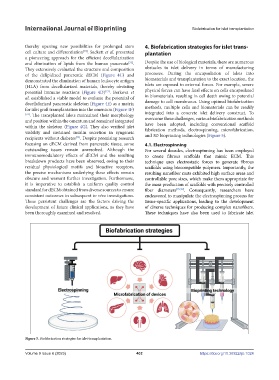
                                                               and 3D bioprinting technologies (Figure 5).
            recipients without diabetes . Despite promising research
                                 [74]
            focusing on dECM derived from pancreatic tissue, some   4.1. Electrospinning
            outstanding issues remain unresolved. Although the   For several decades, electrospinning has been employed
            immunomodulatory effects of dECM and the resulting   to create fibrous scaffolds that mimic ECM. This
            breakdown products have been observed, owing to their   technique uses electrostatic forces to generate fibrous
            residual physiological motifs and bioactive receptors,   scaffolds using biocompatible polymers. Importantly, the
            the precise mechanisms underlying these effects remain   resulting nanofiber mats exhibited high surface areas and
            obscure and warrant further investigation. Furthermore,   controllable pore sizes, which make them appropriate for
            it is imperative to establish a uniform quality control   the mass production of scaffolds with precisely controlled
            standard for dECM obtained from diverse sources to ensure   fiber diameters [75,76] . Consequently, researchers have
            consistent outcomes in subsequent in vivo investigations.   endeavored to manipulate the electrospinning process for
            These persistent challenges are the factors driving the   tissue-specific applications, leading to the development
            development of future clinical applications, as they have   of diverse techniques for producing complex nanofibers.
            been thoroughly examined and resolved.             These techniques have also been used to fabricate islet


            Figure 5. Biofabrication strategies for islet transplantation.


            Volume 9 Issue 6 (2023)                        402                        https://doi.org/10.36922/ijb.1024

