


Page 411 - IJB-9-6
P. 411
International Journal of Bioprinting                                   Biofabrication for islet transplantation


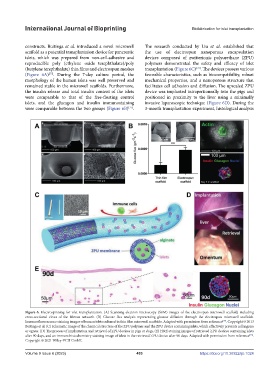
            constructs. Buitinga  et al. introduced a novel microwell   The research conducted by Liu  et al. established that
            scaffold as a potential transplantation device for pancreatic   the use of electrospun nanoporous encapsulation
            islets, which was prepared from non-cell-adhesive and   devices composed of zwitterionic polyurethane (ZPU)
            reproducible poly (ethylene oxide terephthalate)/poly   polymers demonstrated the safety and efficacy of islet
            (butylene terephthalate) thin films and electrospun meshes   transplantation (Figure 6C) . The devices possess various
                                                                                     [78]
            (Figure 6A) . During the 7-day culture period, the   favorable characteristics, such as biocompatibility, robust
                      [77]
            morphology of the human islets was well preserved and   mechanical properties, and a nanoporous structure that
            remained stable in the microwell scaffolds. Furthermore,   facilitates cell adhesion and diffusion. The upscaled ZPU
            the insulin release and total insulin content of the islets   device was implanted intraperitoneally into the pigs and
            were comparable to that of the free-floating control   positioned in proximity to the liver using a minimally
            islets,  and  the  glucagon  and  insulin  immunostaining   invasive laparoscopic technique (Figure 6D). During the
            were comparable between the two groups (Figure 6B) .   3-month transplantation experiment, histological analysis
                                                        [77]


            Figure 6.  Electrospinning  for  islet  transplantation.  (A)  Scanning  electron  microscopy  (SEM)  images  of  the  electrospun  microwell  scaffold,  including
            cross-sectional views of the fibrous network. (B) Glucose flux analysis representing glucose diffusion through the electrospun microwell scaffolds.
            Immunofluorescence staining images of human islets cultured in thin film microwell scaffolds. Adapted with permission from reference . Copyright © 2013
                                                                                                [77]
            Buitinga et al. (C) Schematic image of the chemical structure of the ZPU polymer and the ZPU device containing islets, which effectively prevents cell ingress
            or egress. (D) The process of implantation and retrieval of ZPU devices in pigs or dogs. (E) H&E staining images of retrieved ZPU devices containing islets
            after 90 days, and an immunohistochemistry staining image of islets in the retrieved ZPU device after 90 days. Adapted with permission from reference .
                                                                                                           [78]
            Copyright © 2021 Wiley‐VCH GmbH.
            Volume 9 Issue 6 (2023)                        403                        https://doi.org/10.36922/ijb.1024

