


Page 433 - IJB-9-6
P. 433
International Journal of Bioprinting                                Versatile pomelo peel-inspired structures


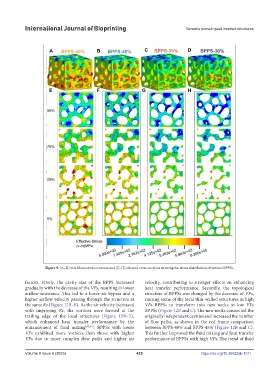
                    Figure 9. (A–D) von Mises stress contours and (E–H) selected cross-sections showing the stress distribution of various BPPSs.


            factors. Firstly, the cavity size of the BPPS increased   velocity, contributing to stronger effects on enhancing
            gradually with the decrease of the VFs, resulting in lower   heat transfer performance. Secondly, the topological
            airflow resistance. This led to a lower air bypass and a   structure of BPPSs was changed by the decrease of VFs,
            higher airflow velocity passing through the structure at   causing some of the local thin-walled structures in high
            the same Re (Figure 12B–E). As the air velocity increased   VFs BPPSs to transform into new necks in low  VFs
            with improving  Re, the vortices were formed at the   BPPSs (Figure 12B and C). The new necks connected the
            trailing edge of the local structures (Figure  12B–E),    originally independent cavities and increased the number
            which enhanced heat transfer performance by the    of flow  paths, as  shown in the red frame comparison
            enhancement of fluid mixing [63,64] . BPPSs with lower   between BPPS-40% and BPPS-45% (Figure 12B and C).
            VFs exhibited more vortices than those with higher   This further improved the fluid mixing and heat transfer
            VFs due to more complex flow paths and higher air   performance of BPPSs with high VFs. The trend of fluid


            Volume 9 Issue 6 (2023)                        425                         https://doi.org/10.36922/ijb.1011

