


Page 432 - IJB-9-6
P. 432
International Journal of Bioprinting                                Versatile pomelo peel-inspired structures


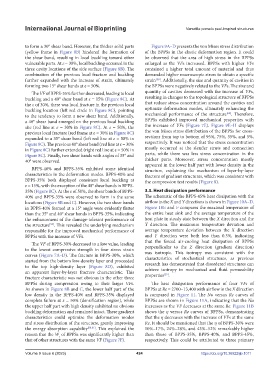
            to form a 30° shear band. However, the thicker solid parts   Figure 9A–D presents the von Mises stress distribution
            (yellow frame in  Figure 8B) hindered the formation of   of the BPPSs in the elastic deformation region. It could
            the shear band, resulting in local buckling toward other   be observed that the area of high stress in the BPPSs
            vulnerable parts. At ε = 30%, local buckling occurred in the   enlarged as the  VFs increased. BPPSs with higher  VFs
            three cavity locations of the side surface (Figure 8B). The   contained a higher total amount of material and thus
            combination of the previous local fracture and buckling   demanded higher macroscopic stress to obtain a specific
            further  expanded  with  the  increase  of  strain,  ultimately   strain . Additionally, the size and quantity of cavities in
                                                                    [58]
            forming two 15° shear bands at ε = 50%.            the BPPSs were negatively related to the VFs. The size and
               The VF of BPPS-35% further decreased, leading to local   quantity of cavities decreased with the increase of VFs,
            buckling and a 40° shear band at ε = 15% (Figure 8C). At   resulting in changes to the topological structure of BPPSs
            the ε of 30%, there was local fracture in the previous local   that reduce stress concentration around the cavities and
            buckling location (left red circle in Figure 8C), pointing   optimize deformation modes, ultimately enhancing the
                                                                                                  [62]
            to the tendency to form a new shear band. Additionally,   mechanical performance of the structure . Therefore,
            a 40° shear band emerged on the previous local buckling   BPPSs exhibited improved mechanical properties with
            site (red line at ε = 30% in Figure 8C). At ε = 50%, the   the increase of  VFs (Figure 7E).  Figure 9E–H displays
            previous local fracture (red frame at ε = 30% in Figure 8C)   the von Mises stress distribution of the BPPSs for cross-
            expanded to a 35° shear band (left red line at ε = 50% in   sections from top to bottom of 95%, 75%, 35%, and 5%,
            Figure 8C). The previous 40° shear band (red line at ε = 30%    respectively. It was noticed that the stress concentration
            in Figure 8C) further extended (right red line at ε = 50% in   mostly occurred at the slender struts and connection
            Figure 8C). Finally, two shear bands with angles of 35° and   parts, while there was less stress concentration in the
            40° were observed.                                 thicker parts. Moreover, stress concentration mostly
                                                               appeared in the lower half part with lower density in the
               BPPS-40% and BPPS-35% exhibited some identical   structure, explaining the mechanism of layer-by-layer
            characteristics in the deformation modes. BPPS-40% and   fracture of gradient structures, which was consistent with
            BPPS-35%  both  displayed  consistent  local  buckling at   the compression test results (Figure 8).
            ε = 15%, with the exception of the 40° shear bands in BPPS-
            35% (Figure 8C). At the ε of 50%, the shear bands of BPPS-  3.3. Heat dissipation performance
            40% and BPPS-35% were observed to form in the same   The schematic of the BPPS-45% heat dissipation with the
            locations (Figure 8B and C). However, the two shear bands   airflow in the X and Y directions is shown in Figure 10A–D.
            in BPPS-40% formed at a 15° angle were evidently flatter   Figure 10E and F compares the maximal temperature of
            than the 35° and 40° shear bands in BPPS-35%, indicating   the entire heat sink and the average temperature of the
            the enhancement of the damage-tolerant performance of   heat plate in steady state between the X direction and the
            the structure . This revealed the underlying mechanism   Y  direction.  The  maximum  temperature deviation  and
                      [59]
            responsible for the improved mechanical performance of   average temperature deviation between the  X direction
            BPPSs with the increase of VFs.                    and  Y direction were both less than 0.3%, indicating
               The VF of BPPS-30% decreased to a low value, leading   that the forced air-cooling heat dissipation of BPPSs
            to the lowest compressive strength in four stress–strain   perpendicular to the  Z direction (gradient direction)
                                                               was isotropic. This isotropy was consistent with the
            curves (Figure 7A–D). The fracture in BPPS-30%, which   characteristics of stochastical structures, as previous
            started from the bottom low-density layer and proceeded   research has demonstrated that disordered structures can
            to the top high-density layer (Figure 8D), exhibited   achieve isotropy in mechanical and fluid permeability
            an apparent layer-by-layer fracture characteristic. This   properties .
                                                                       [25]
            fracture characteristic was not obvious in the other three
            BPPSs during compression owing to their larger  VFs.   The  heat  dissipation  performance  of four  VFs  of
            As shown in Figure 8B and C, the lower half part of the   BPPSs at Re = 2700–13,400 with airflow in the X direction
            low density in the BPPS-40% and BPPS-35% displayed   is compared in  Figure 11. The  Nu versus  Re curves of
            complete failure at ε = 50% (densification region), while   BPPSs are shown in Figure 11A, indicating that the Nu
            the upper half part with high density exhibited no obvious   increases as the VF decreases at the same Re. Figure 11B
            buckling deformation and remained intact. These gradient   shows the η versus Re curves of BPPSs, demonstrating
            characteristics could optimize the deformation modes   that the η decreases with the increase of VFs at the same
            and stress distribution of the structure, greatly improving   Re. It should be mentioned that the η of BPPS-30% were
            the  energy  absorption  capability [60,61] .  This  explained  the   10%–17%, 24%–28%, and 43%–52% remarkably higher
            reason that the W  of BPPSs was significantly higher than   than those of BPPS-35%, BPPS-40%, and BPPS-45%,
                          s
            that of other structures with the same VF (Figure 7F).  respectively. This could be attributed to three primary

            Volume 9 Issue 6 (2023)                        424                         https://doi.org/10.36922/ijb.1011

