


Page 429 - IJB-9-6
P. 429
International Journal of Bioprinting                                Versatile pomelo peel-inspired structures


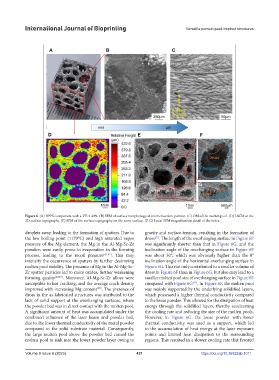
            Figure 6. (A) BPPS component with a VF of 40%. (B) SEM of surface morphology at an intersection portion. (C) OM of the molten pool. (D) LSCM of the
            3D surface topography. (E) SEM of the surface topography on the same surface. (F, G) Local SEM magnification detail of the holes.

            droplets away, leading to the formation of spatters. Due to   gravity and surface-tension, resulting in the formation of
            the low boiling point (1170°C) and high saturated vapor   dross . The length of the overhanging surface in Figure 6F
                                                                   [51]
            pressure of the Mg element, the Mg in the Al-Mg-Sc-Zr   was significantly shorter than that in Figure 6G, and the
            powders were easily prone to evaporation in the forming   inclination angle of the overhanging surface in Figure 6F
            process, leading to the recoil pressure [45-47] . This may   was about 30°, which was obviously higher than the 0°
            intensify the occurrence of spatters by further destroying   inclination angle of the horizontal overhanging surface in
            molten pool stability. The presence of Mg in the Al-Mg-Sc-  Figure 6G. This not only contributed to a smaller volume of
            Zr spatter particles led to more oxides, further weakening   dross in Figure 6F than in Figure 6G, but also may lead to a
            forming quality [48,49] . Moreover, Al-Mg-Sc-Zr alloys were   smaller molten pool size of overhanging surface in Figure 6F
            susceptible to hot cracking, and the average crack density   compared with Figure 6G . In Figure 6F, the molten pool
                                                                                   [52]
            improved with increasing Mg content . The presence of   was mainly supported by the underlying solidified layers,
                                          [50]
            dross in the as-fabricated structures was attributed to the   which possessed a higher thermal conductivity compared
            lack of solid support at the overhanging surfaces, where   to the loose powder. This allowed for the dissipation of heat
            the powder bed was in direct contact with the molten pool.   energy through the solidified layers, thereby accelerating
            A significant amount of heat was accumulated under the   the cooling rate and reducing the size of the molten pools.
            combined influence  of  the  laser beam  and powder  bed,   However, in  Figure 6G, the loose powder with lower
            due to the lower thermal conductivity of the metal powder   thermal conductivity was used as a support, which led
            compared to the solid substrate material. Consequently,   to the accumulation of heat energy at the laser exposure
            the large molten pool above the powder bed caused the   points and limited heat dissipation to the surrounding
            molten pool to sink into the lower powder layer owing to   regions. This resulted in a slower cooling rate that favored

            Volume 9 Issue 6 (2023)                        421                         https://doi.org/10.36922/ijb.1011

