


Page 447 - IJB-9-6
P. 447
International Journal of Bioprinting                                         3D bioprinting for lung tissue


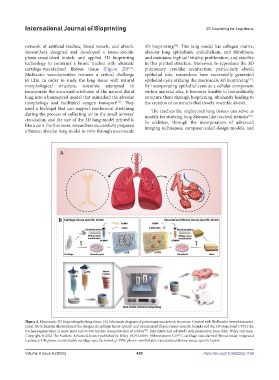
            network of artificial trachea, blood vessels, and alveoli.   3D bioprinting . This lung model has collagen matrix,
                                                                           [36]
            Researchers designed and developed a tissue-specific   alveolar  lung  epithelium,  endothelium,  and  fibroblasts,
            photo-crosslinked bioink, and applied 3D bioprinting   and maintains high cell vitality, proliferation, and viability
            technology to construct a bionic trachea with alternate   in this printed structure. Moreover, to reproduce the 3D
            cartilage-vascularized fibrous tissue (Figure 2B) .   pulmonary cyst-like architecture, particularly alveoli
                                                        [34]
            Multiscale vascularization remains a critical challenge   epithelial side, researchers have successfully generated
            in  LTE. In order to study the lung tissue with natural   epithelial cysts utilizing the macroscale 3D bioprinting .
                                                                                                           [37]
            morphological  structure,  scientists  attempted  to  By incorporating epithelial cysts as a cellular component
            incorporate the structural attributes of the natural distal   within material inks, it becomes feasible to hierarchically
            lung into a bioinspired model that mimicked the alveolar   structure them through bioprinting, ultimately leading to
            morphology and facilitated oxygen transport . They   the creation of constructs that closely resemble alveoli.
                                                   [35]
            used a hydrogel that can support mechanical stretching   The trachea-like engineered lung tissues can serve as
            during the process of collecting air in the small airways’   models for studying lung diseases like tracheal stenosis .
                                                                                                           [38]
            circulation, and the size of the 3D lung model printed is   In addition, through the incorporation of advanced
            like a coin. Furthermore, researchers successfully prepared   imaging techniques, computer-aided design models, and
            a human alveolar lung model in vitro through macroscale


            Figure 2. Macroscale 3D bioprinting for lung tissue. (A) Schematic diagram of pulmonary macroscale structure. Created with BioRender (www.biorender.
            com). (B) Schematic illustration of the designs of cartilage tissue‐specific and vascularized fibrous tissue‐specific bioinks and the 3D‐bioprinted CVFIT for
            trachea regeneration in nude mice and in situ trachea reconstruction of rabbits . Reprinted (and adapted) with permission from John Wiley and Sons.
                                                               [34]
            Copyright © 2022 The Authors. Advanced Science published by Wiley-VCH GmbH. Abbreviations: CVFIT, cartilage‐vascularized fibrous tissue‐integrated
            trachea; p‐CB, photo-crosslinkable cartilage‐specific bioink; p‐VFB: photo-crosslinkable-vascularized fibrous tissue‐specific bioink.

            Volume 9 Issue 6 (2023)                        439                          https://doi.org/10.36922/ijb.1166

