


Page 450 - IJB-9-6
P. 450
International Journal of Bioprinting                                         3D bioprinting for lung tissue


            or nanofibers into the material  inks, thereby providing   positioning these cells within the 3D structure, nanoscale
            enhanced control over the cellular microenvironment and   bioprinting can promote the formation of functional lung
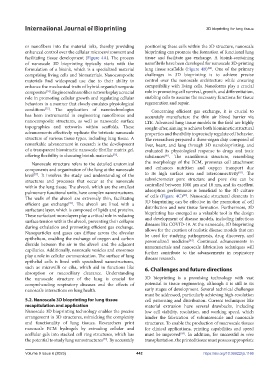
            facilitating  tissue development (Figure  4A).  The  process   tissue and facilitate gas exchange. A bioink-containing
            of nanoscale 3D bioprinting typically starts with the   nanofibrils have been developed for nanoscale 3D-printing
                                                                                          [80]
            formulation of a bioink, which is a specialized material   lung tissue scaffolds (Figure 4B) . One of the primary
            comprising living cells and biomaterials. Nanocomposite   challenges in 3D bioprinting is to achieve precise
            materials find widespread use due to their ability to   control over the nanoscale architecture while ensuring
            enhance the mechanical traits of hybrid organic/inorganic   compatibility with living cells. Nanoforms play a crucial
                     [74]
            composites . Engineered nanofiber networks play a crucial   role in promoting cell survival, growth, and differentiation,
            role in promoting cellular growth and regulating cellular   enabling cells to assume the necessary functions for tissue
            behaviors in a manner that closely emulates physiological   regeneration and repair.
            conditions . The application of nanotechnologies      Concerning efficient gas exchange, it is crucial to
                    [75]
            has  been  instrumental  in  engineering nanofibrous  and   accurately manufacture the thin air–blood barrier via
            nanocomposite structures, as well as nanoscale surface   LTE. Advanced lung tissue models in the field are highly
            topographies and networks within scaffolds. These   sought-after, aiming to achieve both biomimetic structural
            advancements effectively replicate the intricate nanoscale   properties and the ability to precisely regulate cell behavior.
            structure of various tissue types, including lung tissue. A   The researchers prepared a three-organ chip composed of
            remarkable advancement in research is the development   liver, heart, and lung through 3D nanobioprinting, and
            of a transparent biomimetic nanoscale fibrillar matrix gel,   evaluated its physiological response to drugs and toxic
            offering flexibility in choosing bioink materials .  substances . The nanofibrous structure, resembling
                                                 [76]
                                                                       [81]
               Nanoscale structure refers to the detailed anatomical   the morphology of the ECM, promotes cell attachment
            components and organization of the lung at the nanoscale   and enhances nutrition and oxygen transport due
                                                                                                       [82]
            level . It involves the study and understanding of the   to its high surface area and interconnectivity . The
               [77]
            structures  and  processes  that  occur  at  the  nanoscale   submicrometer pore structure and pore size can be
            within the lung tissue. The alveoli, which are the smallest   controlled between 1000 µm and 10 nm, and its excellent
            pulmonary functional units, have complex nanostructures.   adsorption performance is beneficial to the 3D culture
                                                                               [83]
            The walls of the alveoli are extremely thin, facilitating   of cells (Figure 4C) . Nanoscale structural elements in
            efficient gas exchange . The alveoli are lined with a   3D bioprinting can be effective in the promotion of cell
                              [78]
            surfactant layer, which is composed of lipids and proteins.   distribution and new tissue formation. Furthermore, 3D
            These surfactant monolayers play a critical role in reducing   bioprinting has emerged as a valuable tool in the design
            surface tension within the alveoli, preventing their collapse   and development of disease models, including infectious
                                                               diseases like COVID-19. At the nanoscale, 3D bioprinting
            during exhalation and promoting efficient gas exchange.   allows for the creation of realistic disease models that can
            Nanoparticles  and gases can diffuse across the  alveolar   be  used  for  studying  pathogenesis,  drug  discovery,  and
            epithelium, enabling the exchange of oxygen and carbon   personalized medicine . Continued advancements in
                                                                                  [84]
            dioxide between the air in the alveoli and the adjacent   nanomaterials and nanoscale fabrication techniques will
            capillaries. Additionally, nanoscale vesicles and exosomes   further contribute  to the advancements in  respiratory
            play a role in cellular communication. The surface of lung   disease research.
            epithelial cells is lined with specialized nanostructures,
            such as microvilli or cilia, which aid in functions like   6. Challenges and future directions
            absorption or mucociliary clearance. Understanding
            the  nanoscale  structure  of the lung  is  crucial for   3D bioprinting is a promising technology with vast
            comprehending respiratory diseases and the effects of   potential in tissue engineering, although it is still in its
            nanoscale interactions on lung health.             early stages of development. Several technical challenges
                                                               must be addressed, particularly achieving high-resolution
            5.2. Nanoscale 3D bioprinting for lung tissue      cell  patterning and  distribution.  Current  techniques  like
            recapitulation and application                     material extrusion have several drawbacks, including
            Nanoscale 3D bioprinting technology enables the precise   low cell viability, resolution, and working speed, which
            arrangement in 3D structures, mimicking the complexity   hinder the fabrication of submicroscale and nanoscale
            and functionality of lung tissues. Researchers print   structures. To enable the production of macroscale tissues
            nanoscale ECM hydrogels by extruding cellular and   for clinical applications,  printing  capabilities and speed
            acellular gels into stacked cell ring structures, which has   must be improved . In addition, for successful  in  vivo
                                                                              [85]
            the potential to study lung nanostructures . By accurately   transplantation, the printed tissue must possess appropriate
                                             [79]
            Volume 9 Issue 6 (2023)                        442                          https://doi.org/10.36922/ijb.1166

