


Page 451 - IJB-9-6
P. 451
International Journal of Bioprinting                                         3D bioprinting for lung tissue


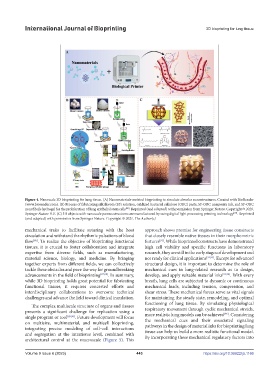
            Figure 4. Nanoscale 3D bioprinting for lung tissue. (A) Nanomaterials-assisted bioprinting to simulate alveolar nanostructures. Created with BioRender
            (www.biorender.com). (B) Process of fabricating silk fibroin (SF) solution, oxidized bacterial cellulose (OBC) paste, SF-OBC composite ink, and SF-OBC
                                                       [80]
            nanofibrils hydrogel for the proliferation of lung epithelial stem cells . Reprinted (and adapted) with permission from Springer Nature. Copyright © 2020,
                                                                                                     [83]
            Springer Nature B.V. (C) 3D objects with nanoscale porous structures are manufactured by using digital light processing printing technology . Reprinted
            (and adapted) with permission from Springer Nature. Copyright © 2021, The Author(s).
            mechanical traits to facilitate suturing with the host   approach shows promise for engineering tissue constructs
            circulation and withstand the rhythmic pulsations of blood   that closely resemble native tissues in their morphometric
            flow . To realize the objective of bioprinting functional   features . While bioprinted constructs have demonstrated
                                                                     [91]
               [86]
            tissues, it is crucial to foster collaboration and integrate   high  cell  viability  and  specific  functions  in  laboratory
            expertise from diverse fields, such as manufacturing,   research, they are still in the early stages of development and
            material science, biology, and medicine. By bringing   not ready for clinical applications [92,93] . Except for advanced
            together experts from different fields, we can collectively   structural design, it is important to determine the role of
            tackle these obstacles and pave the way for groundbreaking   mechanical cues in lung-related research as to design,
            advancements in the field of bioprinting [87,88] . In summary,   develop, and apply suitable material inks [94,95] . With every
            while 3D bioprinting holds great potential for fabricating   breath, lung cells are subjected to dynamic or continuous
            functional tissues, it requires concerted efforts and   mechanical loads, including tension, compression, and
            interdisciplinary collaborations to overcome technical   shear stress. These mechanical forces serve as vital signals
            challenges and advance the field toward clinical translation.  for maintaining the steady state, remodeling, and optimal
                                                               functioning of lung tissue. By simulating physiological
               The complex multiscale structure of organs and tissues
            presents a significant challenge for replication using a   respiratory movement through cyclic mechanical stretch,
                                                                                                 [96]
            single program or tool [89,90] . Future development will focus   more realistic lung models can be achieved . Considering
            on  multisize,  multimaterial,  and  multicell  bioprinting,   the mechanical cues and their associated signaling
            integrating precise modeling of cell–cell interactions   pathways in the design of material inks for bioprinting lung
            and segregation at the intratissue level, combined with   tissue can help us build a more realistic functional model.
            architectural control at the macroscale (Figure 5).  This   By incorporating these mechanical regulatory factors into

            Volume 9 Issue 6 (2023)                        443                          https://doi.org/10.36922/ijb.1166

