


Page 449 - IJB-9-6
P. 449
International Journal of Bioprinting                                         3D bioprinting for lung tissue


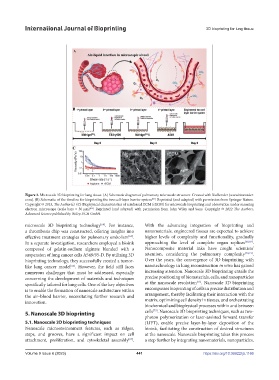
            Figure 3. Microscale 3D bioprinting for lung tissue. (A) Schematic diagram of pulmonary microscale structure. Created with BioRender (www.biorender.
                                                                  [60]
            com). (B) Schematic of the timeline for bioprinting the two cell-layer barrier system . Reprinted (and adapted) with permission from Springer Nature.
            Copyright © 2015, The Author(s). (C) Biophysical characteristics of reinforced ECM (rECM) for microscale bioprinting and observation under scanning
                                       [62]
            electron microscope (scale bars = 50 µm) . Reprinted (and adapted) with permission from John Wiley and Sons. Copyright © 2022 The Authors.
            Advanced Science published by Wiley-VCH GmbH.
            microscale 3D bioprinting technology . For instance,   With  the  advancing integration  of  bioprinting  and
                                            [64]
            a thrombosis chip was constructed, offering insights into   nanomaterials, engineered tissues are expected to achieve
            effective treatment strategies for pulmonary embolism .   higher levels of complexity and functionality, gradually
                                                        [65]
            In a separate investigation, researchers employed a bioink   approaching the level of complete organ replicas [68,69] .
            composed of gelatin-sodium alginate blended with a   Nanocomposite material inks have caught scientists’
            suspension of lung cancer cells A549/95-D. By utilizing 3D   attention, considering the pulmonary complexity [70,71] .
            bioprinting technology, they successfully created a tumor-  Over the years, the convergence of 3D bioprinting with
            like  lung cancer  model . However,  the field  still  faces   nanotechnology in lung reconstruction in vitro has gained
                               [66]
            numerous challenges that must  be addressed,  especially   increasing attention. Nanoscale 3D bioprinting entails the
            concerning the development of materials and techniques   precise positioning of biomaterials, cells, and nanoparticles
                                                                                     [72]
            specifically tailored for lung cells. One of the key objectives   at the nanoscale resolution . Nanoscale 3D bioprinting
            is to enable the formation of nanoscale architecture within   encompasses bioprinting of cells in precise distribution and
            the air–blood  barrier, necessitating  further  research and   arrangement, thereby facilitating their interaction with the
            innovation.                                        matrix, optimizing cell density in tissues, and orchestrating
                                                               biochemical and biophysical processes within and between
                                                                  [73]
            5. Nanoscale 3D bioprinting                        cells . Nanoscale 3D bioprinting techniques, such as two-
                                                               photon polymerization or laser-assisted forward transfer
            5.1. Nanoscale 3D bioprinting techniques           (LIFT), enable precise layer-by-layer deposition of the
            Nanoscale  microenvironment  features,  such  as  ridges,   bioink, facilitating the construction of desired structures
            steps, and grooves, have a significant impact on cell   at the nanoscale. Nanoscale bioprinting takes this process
            attachment, proliferation, and cytoskeletal assembly .   a step further by integrating nanomaterials, nanoparticles,
                                                        [67]
            Volume 9 Issue 6 (2023)                        441                          https://doi.org/10.36922/ijb.1166

