


Page 452 - IJB-9-6
P. 452
International Journal of Bioprinting                                         3D bioprinting for lung tissue


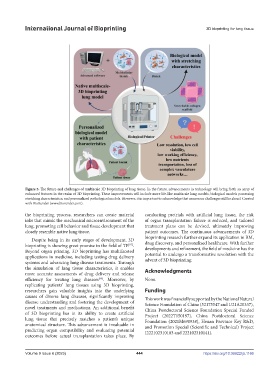
            Figure 5. The future and challenges of multiscale 3D bioprinting of lung tissue. In the future, advancements in technology will bring forth an array of
            enhanced features in the realm of 3D bioprinting. These improvements will include more life-like multiscale lung models, biological models possessing
            stretching characteristics, and personalized pathological models. However, it is important to acknowledge that numerous challenges still lie ahead. Created
            with BioRender (www.biorender.com).

            the bioprinting process, researchers can create material   conducting pretrials with artificial lung tissue, the risk
            inks that mimic the mechanical microenvironment of the   of organ transplantation failure  is reduced, and tailored
            lung, promoting cell behavior and tissue development that   treatment plans can be devised, ultimately improving
            closely resemble native lung tissue.               patient outcomes. The continuous advancements of 3D
               Despite being in its early stages of development, 3D   bioprinting research further expand its application in RM,
            bioprinting is showing great promise in the field of TE .   drug discovery, and personalized healthcare. With further
                                                        [97]
            Beyond  organ  printing,  3D  bioprinting  has  multifaceted   developments and refinement, the field of medicine has the
            applications in medicine, including testing drug delivery   potential to undergo a transformative revolution with the
            systems and advancing lung disease treatments. Through   advent of 3D bioprinting.
            the simulation of lung tissue characteristics, it enables   Acknowledgments
            more accurate assessments of drug delivery and release
            efficiency for  treating  lung  diseases . Moreover, by   None.
                                           [98]
            replicating patients’ lung tissues using 3D bioprinting,
            researchers gain valuable insights into the underlying   Funding
            causes of diverse lung diseases, significantly improving   This work was financially supported by the National Natural
            disease understanding and fostering the development of   Science Foundation of China (52175547 and U21A20337),
            novel treatments and medications. An additional benefit   China Postdoctoral Science Foundation Special Funded
            of 3D bioprinting lies in its ability to create artificial   Project (2022T150197), China Postdoctoral Science
            lung tissue that precisely matches a patient’s unique   Foundation (2021M690938), Henan Province Key R&D,
            anatomical structure. This advancement is invaluable in   and Promotion Special (Scientific and Technical) Project
            predicting organ compatibility and evaluating potential   (222102310183 and 222102310141).
            outcomes before actual transplantation takes place. By


            Volume 9 Issue 6 (2023)                        444                          https://doi.org/10.36922/ijb.1166

