


Page 466 - IJB-9-6
P. 466
International Journal of Bioprinting                             3D bioprinting of in vitro cartilage tissue model


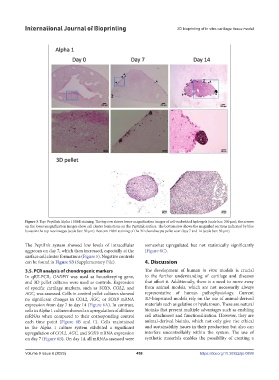
            Figure 3. Top: PeptiInk Alpha 1 H&E staining. The top row shows lower-magnification images of cell-embedded hydrogels (scale bar: 200 µm); the arrows
            on the lower-magnification images show cell cluster formations on the PeptiInk surface. The bottom row shows the magnified sections indicated by blue
            boxes in the top row images (scale bar: 50 µm). Bottom: H&E staining of the 3D chondrocyte pellet over days 7 and 14 (scale bar: 50 µm).

            The PeptiInk system showed low levels of intracellular   somewhat  upregulated  but  not  statistically  significantly
            aggrecan on day 7, which then increased, especially at the   (Figure 6C).
            surface cell cluster formations (Figure 5). Negative controls
            can be found in Figure S3 (Supplementary File).    4. Discussion
            3.5. PCR analysis of chondrogenic markers          The  development  of  human  in vitro  models  is  crucial
            In qRT-PCR,  GADPH was used as housekeeping gene,   to the further understanding of cartilage and diseases
            and 3D pellet cultures were used as controls. Expression   that affect it. Additionally, there is a need to move away
            of specific cartilage markers, such as  SOX9,  COL2, and   from animal models, which are not necessarily always
            AGC, was assessed. Cells in control pellet cultures showed   representative of  human  pathophysiology.  Current
            no significant changes in COL2,  AGC, or  SOX9 mRNA   3D-bioprinted models rely on the use of animal-derived
            expression from day 7 to day 14 (Figure 6A). In contrast,   materials such as gelatine or hyaluronan. These are natural
            cells in Alpha 1 cultures showed an upregulation of all three   bioinks that present multiple advantages such as enabling
            mRNAs when compared to their corresponding control   cell attachment and functionalization. However, they are
            each time point (Figure 6B and  C). Cells maintained   animal-derived bioinks, which not only give rise ethical
            in the Alpha 1 culture system exhibited a significant   and sustainability issues in their production but also can
            upregulation of COL2, AGC, and SOX9 mRNA expression   interfere uncontrollably within the system. The use of
            on day 7 (Figure 6B). On day 14, all mRNAs assessed were   synthetic materials enables the possibility of creating a


            Volume 9 Issue 6 (2023)                        458                        https://doi.org/10.36922/ijb.0899

