


Page 467 - IJB-9-6
P. 467
International Journal of Bioprinting                            3D bioprinting of in vitro cartilage tissue model


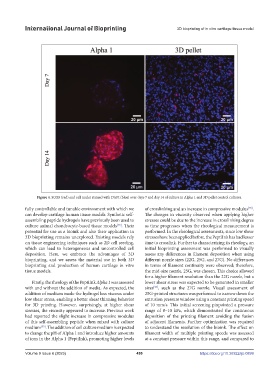
                 Figure 4. SOX9 (red) and cell nuclei stained with DAPI (blue) over days 7 and day 14 of culture in Alpha 1 and 3D pellet control cultures.

            fully controllable and tunable environment with which we   of crosslinking and an increase in compressive modulus .
                                                                                                           [35]
            can develop cartilage human tissue models. Synthetic self-  The changes in viscosity observed when applying higher
            assembling peptide hydrogels have previously been used to   stresses could be due to the increase in crosslinking degree
            culture animal chondrocyte-based tissue models . Their   as time progresses when the rheological measurement is
                                                   [35]
            potential for use as a bioink and also their application in   performed. In the rheological assessments, since low shear
            3D bioprinting remains unexplored. Existing models rely   stresses have been applied before, the PeptiInk has had lesser
            on tissue engineering techniques such as 2D cell seeding,   time to crosslink. Further to characterizing its rheology, an
            which can lead to heterogeneous and uncontrolled cell   initial bioprinting assessment was performed to visually
            deposition. Here, we embrace the advantages of 3D   assess any differences in filament deposition when using
            bioprinting, and we assess the material use in both 3D   different nozzle sizes (22G, 25G, and 27G). No differences
            bioprinting and production of human cartilage  in vitro   in terms of filament continuity were observed; therefore,
            tissue models.                                     the mid-size nozzle, 25G, was chosen. This choice allowed
                                                               for a higher filament resolution than the 22G nozzle, but a
               Firstly, the rheology of the PeptiInk Alpha 1 was assessed   lower shear stress was expected to be generated in smaller
            with and without the addition of media. As expected, the   sizes ,  such  as the  27G  nozzle.  Visual  assessment of
                                                                   [36]
            addition of medium made the hydrogel less viscous under   25G-printed structures was performed to narrow down the
            low shear stress, enabling a better shear thinning behavior   extrusion pressure window using a constant printing speed
            for 3D printing. However, surprisingly, at higher shear   of 10 mm/s. This initial screening pinpointed a pressure
            stresses, the viscosity appeared to increase. Previous work   range of 8–10 kPa, which demonstrated the continuous
            had reported the slight increase in compressive modulus   deposition of the printing filament avoiding the fusion
            of this self-assembling peptide when mixed with culture   of adjacent filaments. Further optimization was required
            medium . The addition of cell culture medium is expected   to understand the resolution of the bioink. The effect on
                   [35]
            to change the pH of Alpha 1 and introduce higher amounts   filament  width  of  multiple  printing  speeds  was  assessed
            of ions in the Alpha 1 (PeptiInk), promoting higher levels   at a constant pressure within this range, and compared to


            Volume 9 Issue 6 (2023)                        459                        https://doi.org/10.36922/ijb.0899

