


Page 67 - IJB-9-6
P. 67
International Journal of Bioprinting                              3D Aerosol Jet® printing for microstructuring


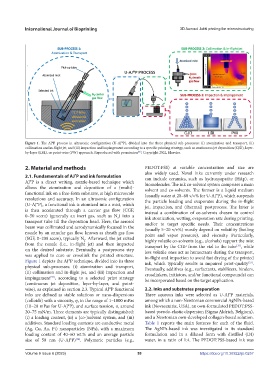
            Figure 1. The AJ®P process in ultrasonic configuration (U-AJ®P), divided into the three physical sub-processes: (i) atomization and transport, (ii)
            collimation and in-flight jet, and (iii) impaction and impingement according to a specific printing strategy, such as continuous jet deposition (CJD), layer-
                                                            [56]
            by-layer (LBL), or point-wise (PW) approach. Reproduced with permission , Copyright 2022, Elsevier.

            2. Material and methods                            PEDOT:PSS) at variable concentration and size are
                                                               also widely used. Novel inks currently under research
            2.1. Fundamentals of AJ P and ink formulation      can include ceramics, such as hydroxyapatite (HAp), or
                                 ®
            AJ®P is a direct writing, nozzle-based technique which   biomolecules. The ink co-solvent system comprises a main
            allows the atomization and deposition of a (multi)-  solvent and co-solvents. The former is a liquid medium
            functional ink on a free-form substrate, at high microscale   (usually water at 20–60 v/v% for U-AJ®P), which suspends
            resolutions and accuracy. In an ultrasonic configuration   the particle loading and evaporates during the in-flight
            (U-AJ®P), a functional ink is atomized into a mist, which   jet, impaction, and (thermal) postprocess. The latter is
            is then accelerated through a carrier gas flow (CGF,   instead  a  combination  of  co-solvents  chosen  to  control
            0–50  sccm) (generally an inert gas, such as N ) into a   ink atomization, wetting, evaporation rate during printing,
                                                   2
            transport tube till the deposition head. Here, the aerosol   and/or  to target specific  needs.  Their  concentrations
            beam was collimated and aerodynamically focused in the   (usually 5–20 v/v%) mostly depend on volatility (boiling
            nozzle by an annular gas flow, known as sheath gas flow   point and vapor pressure), and viscosity. Particularly,
            (SGF, 0–200 sccm), typically N . Afterward, the jet exited   highly volatile co-solvents (e.g., alcohols) support the mist
                                     2
            from the nozzle (i.e., in-flight jet) and then impacted   transport by the CGF from the vial to the tube , while
                                                                                                      [35]
            on the desired substrate. Eventually, a postprocess step   less volatile ones act as humectants during the transport,
            was applied to cure or crosslink the printed structure.   in-flight and impaction to avoid fast drying of the printed
            Figure 1 depicts the AJ®P technique, divided into its three   ink, which typically results in impaired print-quality .
                                                                                                           [33]
            physical sub-processes: (i) atomization and transport,   Eventually, additives (e.g., surfactants, stabilizers, binders,
            (ii) collimation and in-flight jet, and (iii) impaction and   crosslinkers, initiators, and/or functional compounds) can
            impingement , according to  a selected print strategy   be incorporated based on the target application.
                      [33]
            (continuous jet deposition, layer-by-layer, and point-
            wise), as explained in section 2.3. Typical AJ®P functional   2.2. Inks and substrates preparation
            inks are defined as stable solutions or nano-dispersions   Three  aqueous  inks  were  selected  as  U-AJ®P  materials,
            (colloids) with a viscosity, η, in the range of 1–1000 mPas   among which a non-Newtonian commercial AgNPs-based
            (10–20 mPas for U-AJ®P), and surface tension, σ, around   ink (Novacentrix, USA), an own-formulated PEDOT:PSS-
            20–75 mN/m. Three elements are typically distinguished:   based pseudo-elastic dispersion (Sigma Aldrich, Belgium),
            (i) a loading content, (ii) a (co-)solvent system, and (iii)   and a Newtonian own-developed collagen-based solution.
            additives. Standard loading contents are conductive metal   Table 1 reports the main features for each of the fluid.
            (Ag, Cu, Au, Pt) nanoparticles (NPs), with a maximum   The  AgNPs-based  ink  was  investigated  in  its  standard
            loading content of 40–60 wt.% and an average particle   formulation and in a diluted form with distilled (DI)
            size of 50  nm (U-AJ®P) . Polymeric particles (e.g.,   water, in a ratio of 1:4. The PEDOT:PSS-based ink was
                                 [34]
            Volume 9 Issue 6 (2023)                         59                        https://doi.org/10.36922/ijb.0257

