


Page 69 - IJB-9-6
P. 69
International Journal of Bioprinting                              3D Aerosol Jet® printing for microstructuring


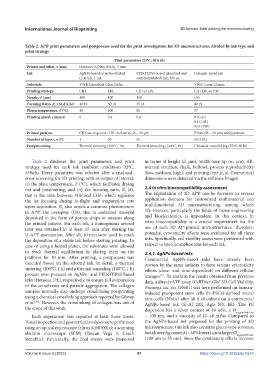
            Table 2. AJ®P print parameters and postprocess used for the print investigation for 3D microstructures, divided by ink type and
            print strategy
                                                  Print parameters (23°C, 50% rh)
             Printer and offset, z [mm]  Optomec AJ300s (USA), 3 mm
             Ink                   AgNPs-based or water-diluted   PEDOT:PSS-based (standard and   Collagen-based ink
                                   (1:4) ink, 1 mL         own-formulated) ink, 850 µL
             Substrate             VWR Superfrost Glass Slides                      VWR Cover Glasses
             Printing strategy     CJD         LBL         CJD or LBL               CJD, LBL or PW
             Nozzle, Ø [μm]        300         100         150                      150
             Focusing Ratio, R  = SGF/CGF  40:10  30:18    35:18                    40:19
                        f
             Platen temperature, T [°C]  40    100         80                       37
             Printing speed, s (mm/s)  0       0.4         0.4                      0 (CJD)
                                                                                    0.4 (LBL)
                                                                                    0.01 (PW)
             Printed patterns      CJD-not required / LBL: 6×4 array, Ø = 50 µm     Pillars (Ø = 50 µm) and pyramids
             Number of layers, n (#)  1        50          50                       50 (LBL)
             Postprocessing        Thermal sintering (200°C, 1h)  Thermal annealing (140°C, 1h)  Chemical crosslinking (EDC-NHS)


               Table 2 discloses the print parameters and print   in terms of height (h, μm), width base-tip (w, μm), AR,
            strategy used for each ink (ambient conditions 22°C,   internal  structure  (bulk,  hollow),  process  reproducibility
            55%rh). Every parameter was selected after a trial-and-  (low, medium, high), and printing time (t, s). Geometrical
            error screening for 3D printing, with as output of interest:   dimensions were detected via the software ImageJ.
            (i) the plate temperature, T (°C), which facilitates drying
            out and presintering, and (ii) the focusing ratio,  R  (#),   2.4 In vitro biocompatibility assessment
                                                      f
            that is the ratio between  SGF and  CGF, which regulates   The exploitation of 3D AJ®P can be foreseen in several
            the jet focusing during in-flight and evaporation rate   application domains for customized multimaterial and
            upon deposition. R   also avoids a common phenomenon   multifunctional 3D microstructuring, among which
                           f
            in AJ®P: the overspray (OS), that is undesired material   life  sciences,  particularly  the  fields  of  tissue  engineering
            deposited in the form of porous drops or streams along   and bioelectronics, is impendent. In this context, in
            the printed pattern. For each ink, a homogenous aerosol   vitro biocompatibility is a crucial requirement for the
            mist was obtained in at least 15 min after starting the   use of such 3D AJ®-printed microstructures. Therefore,
            U-AJ®P atomization. After all, 10 min were used to reach   potential cytotoxicity effects were evaluated for all three
            the deposition of a stable ink before starting printing. In   inks. Specifically, cell viability assays were performed with
            case of using a heated platen, the substrates were allowed   respect to specific applications for each ink.
            to reach thermal equilibrium by placing them on the   2.4.1. AgNPs-based inks
            platform for 10 min. After printing, a postprocess was   Commercial AgNPs-based inks have already been
            executed  based  on  the  selected  ink.  In  detail,  a  thermal   proven by the same authors to have serious cytotoxicity
            sintering (200°C, 1 h) and a thermal annealing (140°C, 1 h)   effects (dose- and time-dependent) on different cellular
            process were pursued on AgNPs- and PEDOT:PSS-based   lineages . To confirm the results obtained from previous
                                                                     [37]
            inks (Heraeus, DE), respectively, to ensure full evaporation   data, a direct rATP assay (CellTiter-Glo® 3D Cell Viability,
            of the co-solvents and particle aggregation. The collagen   Promega cat. no. G9681) was here performed on human-
            samples normally also undergo crosslinking postprinting   induced pluripotent stem cells (h-iPSCs)-derived neural
            using a chemical crosslinking approach reported by Gibney    stem cells (NSCs) after 48 h of culture on a commercial
            et al. . However, the crosslinking of collagen was out of   AgNPs-based ink (SI-AJ 20X, Agfa NV, BE). This PE
                [36]
            the scope of this work.                            dispersion has a silver content of 19 wt%, a Ø
                                                                                                      avg,particle size
               Each experiment was repeated at least three times.   ~ 100 nm, and a viscosity of 12–18 mPas. Compared to
            Visual inspection and geometrical analyses were performed   the AgNPs-based ink proposed for the printing of 3D
            using an optical microscope (Hirox KH8700) or a scanning   microstructure, this ink also contains glycol-type solvents,
            electron microscope (SEM) (Tescan Vega 3, Czech    but a lower Ag content (~ 60% lower) and a larger Ø avg,particle size
            Republic). Particularly, the final shapes were inspected   (100 nm vs 35 nm). Since the cytotoxicity effects increase


            Volume 9 Issue 6 (2023)                         61                        https://doi.org/10.36922/ijb.0257

