


Page 72 - IJB-9-6
P. 72
International Journal of Bioprinting                              3D Aerosol Jet® printing for microstructuring


                                                ®
                                      3D-LBL AJ P poor quality results on AgNPs-based ink
                                       Not diluted                         Diluted (AgNPs:DI water ratio of 1:4)

                a                            b                               c               d


                                                                500 µm
                                    250 µm                                            100 µm        250 µm


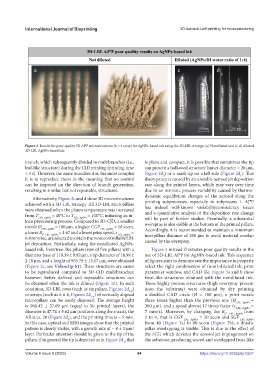
            Figure 3. Results for poor-quality 3D AJ®P microstructures (6 × 4 array) for AgNPs-based ink using the 3D-LBL strategy. (a) Nondiluted and (c, d) diluted
            3D-LBL AgNPs-based ink.

            branch, which subsequently divided in multibranches (i.e.,   is plane and compact, it is possible that sometimes the tip
            leaf-like structure) during the CJD printing (printing time   can present a hollowed structure (inner diameter < 20 µm,
            < 3 s). However, the more branches it is, the more complex   Figure 2d ) or a mark-up on a left side (Figure 2d ). This
                                                                                                        1
                                                                       3
            it is to reproduce them in the meaning that no control   discrepancy is caused by an unstable aerosol jet deposition
            can be imposed on the direction of branch generation,   rate along the printed layers, which may vary over time
            resulting in similar, but not repeatable, structures.  due to an intrinsic process variability caused by thermo-
                Alternatively, Figure 2c and d show 3D microstructures   dynamic equilibrium changes of the aerosol along the
            achieved with a 3D-LBL strategy. All 3D-LBL micropillars   printing subprocesses, especially in subprocess 1. AJ®P
            were obtained when the platen temperature was increased   has indeed well-known variability/consistency issues
            from T CJD, AgNPs  = 40°C to T LBL, AgNPs  = 100°C, initiating an in-  and a quantitative analysis of the deposition rate change
            loco presintering process. Compared to 3D-CJD, a smaller   will  be  part  of further  studies.  Eventually,  a substantial
            nozzle Ø LBL, AgNPs  = 100 μm, a higher CGF  LBL, AgNPs  = 18 sccm,   overspray is also visible at the bottom of the printed pillars.
            a lower R ,    = 1.67 and a lower print speed, s  LBL, AgNPs  =    Accordingly, it is recommended to maintain a minimum
                   f  LBL, AgNPs
            0.4 mm/sec, are selected to obtain the most controllable LBL   interpillars distance of 200 µm to avoid material overlap
            jet deposition. Particularly, using the nondiluted AgNPs-  caused by the overspray.
            based ink, frost/tree-like pillars (row of five pillars) with a   Figure 3 instead illustrates poor quality results in the
            diameter base of 110.39 ± 9.82 µm, a tip diameter of 18.99 ±   use of 3D-LBL AJ®P for AgNPs-based ink. This sequence
            2.18 µm, and a height of 955.79 ± 15.17 µm, were obtained   of figures aims to demonstrate the importance to properly
            (Figure 2c, see Videoclip S1). These structures are easier   select the right combination of (non)-diluted ink, print
            to be reproduced compared to 3D-CJD multibranches;   parameter window, and CAD file. Figure 3a and b show
            however,  better  defined  and repeatable  structures  can   frost-like structures obtained with the nondiluted ink.
            be obtained when the ink is diluted (Figure 2d). In such   These highly porous structures (high overspray present
            condition, 3D-LBL rows (such as six pillars, Figures 2d )   onto the substrate) were obtained by dry printing
                                                        1-2
            or arrays (such as 6 × 4, Figures 2d ) of vertically aligned   a  doubled  CAD  circle  (Ø  =  100  µm),  a  print  nozzle
                                        3-4
            micropillars can be easily disposed. The average height   three times higher than the previous one (Ø LBL, AgNPs  =
            is  960.42  ±  37.69 µm  (equal  to  50 printed  layers),  the   300 μm), and a speed almost 17 times faster (s  LBL, AgNPs  =
            diameter is 47.74 ± 5.62 µm (uniform along the z-axis), the   7  mm/s).  Moreover,  by  changing  the  R ,   LBL, AgNPs  from
                                                                                                 f
            AR is ca. 20 (Figure 2d ), and the printing time is ~ 5 min.   2 to 4, that is CGF  LBL, AgNPs  = 20 sccm and SGF  LBL, AgNPs
                              3
            In this case, optical and SEM images show that the printed   from 40 (Figure 3a) to 80 sccm (Figure 3b), a drastic
            pattern is clearly visible, with a growth rate of ~ 8 ± 1 µm/  pillar overlapping is visible. This is due to the effect of
            layer. Particular attention should be given to the tip of the   the SGF, which deviates the aerosol jet impingement on
            pillars: if in general the tip is depicted as in Figure 2d , that   the substrate, producing waved and overlapped frost-like
                                                      4

            Volume 9 Issue 6 (2023)                         64                        https://doi.org/10.36922/ijb.0257

