


Page 77 - IJB-9-6
P. 77
International Journal of Bioprinting                              3D Aerosol Jet® printing for microstructuring


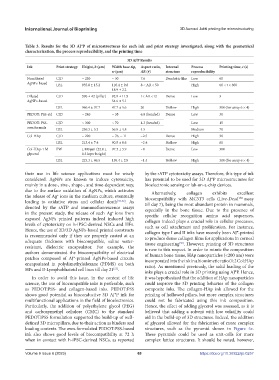
            Table 3. Results for the 3D AJ®P of microstructures for each ink and print strategy investigated, along with the geometrical
            characterization, the process reproducibility, and the printing time
                                                       3D AJ P Results
                                                           ®
             Ink         Print strategy  Height, h (μm)  Width base-tip,  Aspect ratio,   Internal   Process   Printing time, t (s)
                                                 w (μm)      AR (#)     structure  reproducibility
             Nondiluted   CJD       ~ 230        ~ 30        7.6        Dendritic-like  Low    60
             AgNPs-based  LBL       955.8 ± 15.2  110.4 ± 9.8   8 < AR < 50        High        60 < t < 300
                                                 18.9 ± 2.2
             Diluted     CJD        590 ± 42 (pillar)  92.9 ± 11.9   1< AR <12  Dense  Low     3
             AgNPs-based                         54.6 ± 5.1
                         LBL        960.4 ± 37.7  47.7 ± 5.6  20        Hollow     High        300 (for array 6 × 4)
             PEDOT: PSS-std  CJD    ~ 240        ~ 35        6.8 (bended)  Dense   Low         30
             PEDOT: PSS-  CJD       ~ 300        ~ 70        4.3 (bended)          Low         15
             own formula
                         LBL        256.3 ± 5.3  56.8 ± 4.8  4.5                   Medium      70
             Col-HAp     CJD        ~ 220        ~ 76, ~ 11  ~2.5       Dense      High        30
                         LBL        213.4 ± 7.4  90.5 ± 8.6  ~2.4       Hollow     High        60
             Col-HAp-1 M   PW       ±400 µm (22.0 ±   97.3 ± 3.9  ~4    Dense      Low         300
             glycerol               0.5 layer height)
                         LBL        223.3 ± 46.5  159.4 ± 2.9  ~1.4     Hollow     High        300 (for array 6 × 4)

            their use in life science applications must be wisely   by the rATP cytotoxicity assays. Therefore, this type of ink
            considered. AgNPs are known to induce cytotoxicity,   has potential to be used for 3D AJ®P microstructures for
            mainly in a dose-, size-, shape-, and time-dependent way,   bioelectronic sensing or lab-on-a-chip devices.
            due  to the surface  oxidation  of  AgNPs,  which  activates   Alternatively,  collagen  exhibits  excellent
            the release of Ag  ions in the medium culture, eventually   biocompatibility with MC3T3 cells (Live-Dead TM  assay
                         +
            leading to oxidative stress and cellular death [50-52] . As   till day 7), being the most abundant protein in mammals,
            denoted by the rATP and immunofluorescence assays   especially in the bone tissue. Due to the presence of
            in the present study, the release of such Ag ions from   specific  cellular  recognition  amino  acid  sequences,
                                                 +
            exposed AgNPs printed patterns indeed induced high   collagen indeed plays a crucial role in cellular processes,
            levels of cytotoxicity on h-iPSC-derived NSCs and HFs.   such as cell attachment and proliferation. For instance,
            Hence, the use of 2D/3D AgNPs-based printed constructs   collagen type I and II inks have recently been AJ®-printed
            is recommended only if they are properly coated at an   to produce dense collagen films for applications in corneal
            adequate thickness with biocompatible, saline water-  tissue engineering . However, printing of 3D structures
                                                                              [36]
            resistant,  dielectric  encapsulator.  For  example,  the   is new to this respect. In order to mimic the composition
            authors demonstrated the biocompatibility of electrical   of human bone tissue, HAp nanoparticles (<200 nm) were
            patches  composed  of  AJ®-printed  AgNPs-based  circuits   incorporated into the ink in a biomimetic ratio (1:2 Col:HAp
            encapsulated in polydimethylsiloxane (PDMS) on both   ratio). As mentioned previously, the solid loading of the
            HFs and B-Lymphoblastoid cell lines till day 21 .
                                                 [53]
                                                               inks plays a crucial role in 3D printing using AJ®P. Hence,
               In  order  to  avoid  this  issue,  in  the  context  of  life   it was hypothesized that the addition of HAp nanoparticles
            science, the use of biocompatible inks is preferable, such   could improve the 3D printing behavior of the collagen
            as PEDOT:PSS- and collagen-based inks. PEDOT:PSS   composite inks. The collagen-HAp ink allowed for the
            shows good potential as bioconductive 3D AJ®P ink for   printing of hollowed pillars, but more complex structures
            multifunctional applications in the field of bioelectronics.   could not be fabricated using this ink composition.
            Particularly, the addition of  polyethylene  glycol  (PEG)   Hence, the effect of adding glycerol was assessed, as it is
            and carboxymethyl cellulose (CMC) to the standard   believed that adding a solvent with low volatility could
            PEDOT:PSS formulation supported the build-up of well-  aid in the build-up of 3D structures. Indeed, the addition
            defined 3D micropillars, due to their action as binders and   of glycerol allowed for the fabrication of more complex
            loading contents. The own-formulated PEDOT:PSS-based   structures, such as the pyramid shown in  Figure 5e.
            ink also shows good levels of biocompatibility at 72  h   These pyramids could be used as unit-cells for more
            when in contact with h-iPSC-derived NSCs, as reported   complex lattice structures. It should be noted, however,

            Volume 9 Issue 6 (2023)                         69                        https://doi.org/10.36922/ijb.0257

