


Page 74 - IJB-9-6
P. 74
International Journal of Bioprinting                              3D Aerosol Jet® printing for microstructuring


                                3D AJ P results on Collagen-based ink                       Poor quality
                                      ®
                                                                                               results
                            CJD                                LBL                             LBL

                    a                        b                     c                     d


               Col-HAp


                                  100 µm                250 µm               250 µm                 250 µm

                         PW                                   LBL                              LBL

                    e                       f 1                    f 2                   h
               Col-HAp-1M glycerol                        250 µm               250 µm    i      PW  250 µm


                                                             d2


                                  250 µm      g                              1000 µm                  250 µm


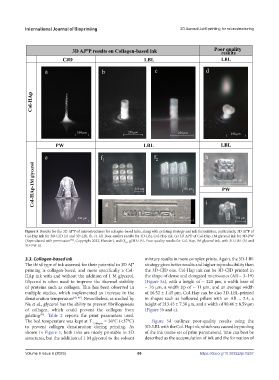
            Figure 5. Results for the 3D AJ®P of microstructures for collagen-based inks, along with printing strategy and ink formulation; particularly, 3D AJ®P of
            Col-Hap ink for 3D-CJD (a) and 3D-LBL (b, c). (d) Poor-quality results for 3D-LBL Col-Hap ink. (e) 3D AJ®P of Col-Hap-1M glycerol ink for 3D-PW
            (Reproduced with permission , Copyright 2022, Elsevier), and (f , g)3D-LBL. Poor quality results for Col-Hap-1M glycerol ink, with 3D-LBL (h) and
                               [56]
                                                      1,2
            3D-PW (i).
            3.3. Collagen-based ink                            mixture results in more complex prints. Again, the 3D-LBL
            The third type of ink assessed for their potential in 3D AJ®   strategy gives better results and higher reproducibility than
            printing is collagen-based, and more specifically a Col-  the 3D-CJD one. Col-Hap ink can be 3D-CJD printed in
            HAp ink with and without the addition of 1 M glycerol.   the shape of dense and elongated microcones (AR ~ 3–19)
            Glycerol is often used to improve the thermal stability   (Figure 5a), with a height of ~ 220 µm, a width base of
            of proteins such as collagen. This has been observed in   ~ 76 µm, a width tip of ~ 11 µm, and an average width
            multiple studies, which implemented an increase in the   of 16.52 ± 1.45 µm. Col-Hap can be also 3D-LBL-printed
            denaturation temperature [42-48] . Nevertheless, as studied by   in shapes such as hollowed pillars with an AR = 2.4, a
            Na et al., glycerol has the ability to prevent fibrillogenesis   height of 213.43 ± 7.38 µm, and a width of 90.46 ± 8.59 µm
            of collagen, which could prevent the collagen from   (Figure 5b and c).
            gelating .  Table 2 reports the print parameters used.
                  [48]
            The bed temperature was kept at T  Collagen  = 30°C (<37°C)   Figure 5d outlines poor-quality results using the
            to prevent collagen denaturation during printing. As   3D-LBL with the Col-Hap ink, which was caused by pooling
            shown in Figure 5, both inks are nicely printable in 3D   of the ink (same set of print parameters). This can best be
            structures, but the addition of 1 M glycerol to the solvent   described as the accumulation of ink and the formation of


            Volume 9 Issue 6 (2023)                         66                        https://doi.org/10.36922/ijb.0257

