


Page 73 - IJB-9-6
P. 73
International Journal of Bioprinting                              3D Aerosol Jet® printing for microstructuring


                                       ®
                                 3D AJ P results on PEDOT:PSS-based ink               Poor quality results
                            CJD           c                     LBL (own formula)    d
                        a
                    Standard formula                                                            250 µm


                                250 µm
                                                                                     e
                        b
                    Own formula   250 µm


                                 250 µm                                     250 µm             250 µm


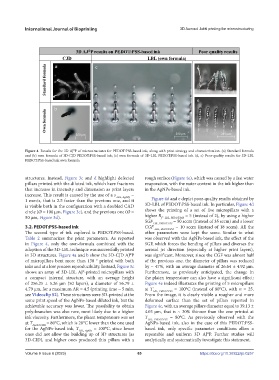
            Figure 4. Results for the 3D AJ®P of microstructures for PEDOT:PSS-based ink, along with print strategy and characterization. (a) Standard formula
            and (b) own formula of 3D-CJD PEDOT:PSS-based ink; (c) own formula of 3D-LBL PEDOT:PSS-based ink. (d, e) Poor-quality results for 3D-LBL
            PEDOT:PSS-based ink own formula.


            structures. Instead,  Figure 3c and  d highlight defected   rough surface (Figure 4e), which was caused by a fast water
            pillars printed with the diluted ink, which have fractures   evaporation, with the water content in the ink higher than
            that increase in intensity and dimension as print layers   in the AgNPs-based ink.
            increase. This result is caused by the use of a s  LBL, AgNPs  =
            1 mm/s, that is 2.5 faster than the previous one, and it   Figure 4d and e depict poor-quality results obtained by
            is visible both in the configuration with a doubled CAD   3D-LBL of PEDOT:PSS-based ink. In particular, Figure 4d
            circle (Ø = 100 µm, Figure 3c), and the previous one (Ø =   shows the printing of a set of five micropillars with a
            50 µm, Figure 3d).                                 higher R ,       = 5 (instead of 2), by using a higher
                                                                      f  LBL, PEDOT:PSS
                                                               SGF          = 50 sccm (instead of 35 sccm) and a lower
            3.2. PEDOT:PSS-based ink                           CGF  LBL, PEDOT:PSS   = 10 sccm (instead of 18 sccm). All the
                                                                     LBL,  PEDOT:PSS
            The second type of ink explored is PEDOT:PSS-based.   other parameters were kept the same. Similar to what
            Table 2 summarizes the print parameters. As reported   was observed with the AgNPs-based ink, the effect of the
            in  Figure 4, only the own-formula combined with the   SGF, which forces the bending of pillars and diverses the
            adoption of the 3D-LBL technique was successfully printed   aerosol  jet  direction  (especially  at  higher  print  layers),
            in 3D structures. Figure 4a and b show the 3D-CJD AJ®P   was significant. Moreover, since the CGF was almost half
            of  micropillars  bent  more  than  130  °  printed  with  both   of the previous one, the diameter of pillars was reduced
            inks and at a low process reproducibility. Instead, Figure 3c    by ~ 47%, with an average diameter of 26.64 ± 4.92 µm.
            shows an array of 3D-LBL AJ®-printed micropillars with   Furthermore, as previously anticipated, the change in
            a compact internal structure, with an average height   the platen temperature can also have a significant effect:
            of  256.25  ±  5.26  µm  (50  layers),  a  diameter  of  56.79  ±   Figure 4e indeed illustrates the printing of 5 micropillars
            4.79 µm, for a maximum AR = 4.5 (printing time ~ 5 min,   at  T LBL, PEDOT:PSS  = 100°C (instead of 80°C), with  n  = 25.
            see Videoclip S2). These structures were 3D-printed at the   From the image, it is clearly visible a rougher and more
            same print speed of the AgNPs-based diluted ink, but the   deformed surface than the set of pillars reported in
            achievable accuracy was lower. The possibility to obtain   Figure 4c, with an average pillars diameter equal to 39.13 ±
            poly-branches was also rare, most likely due to a higher   4.03 µm, that is ~ 30% thinner than the one printed at
            ink viscosity. Furthermore, the platen temperature was set   T LBL, PEDOT:PSS  = 80°C. As previously observed with the
            at T PEDOT:PSS  = 80°C, which is 20°C lower than the one used   AgNPs-based ink, also in the case of this PEDOT:PSS-
            for the AgNPs-based ink, T LBL, AgNPs  = 100°C, since lower   based ink, only specific parameter conditions allow a
            ones did not allow the building up of 3D structures (as   repeatable and uniform 3D AJ®P. Further studies will
            3D-CJD), and higher ones produced thin pillars with a   analytically and systematically investigate this statement.

            Volume 9 Issue 6 (2023)                         65                        https://doi.org/10.36922/ijb.0257

