


Page 71 - IJB-9-6
P. 71
International Journal of Bioprinting                              3D Aerosol Jet® printing for microstructuring


                                               3D AJ P results on AgNPs-based ink
                                                    ®
                    Not diluted                        Diluted (AgNPs:DI water ratio of 1:4)
                  a              b 1               b 2                 b 3                b 4


                CJD


                        100 µm              150 µm              150 µm             150 µm             150 µm

                   c c          d 1              d 2            d 3                   d 4


                LBL


                      500 µm             250 µm         100 µm                  50 µm               50 µm


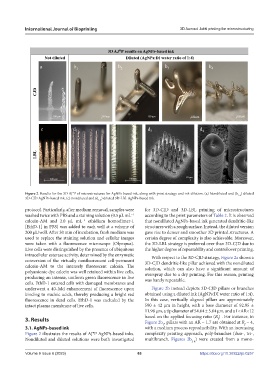
            Figure 2. Results for the 3D AJ®P of microstructures for AgNPs-based ink, along with print strategy and ink dilution. (a) Nondiluted and (b ) diluted
                                                                                                       1-4
            3D-CJD AgNPs-based ink; (c) nondiluted and (d ) diluted 3D-LBL AgNPs-based ink.
                                           1-4
            protocol. Particularly, after medium removal, samples were   for 3D-CJD and 3D-LBL printing of microstructures
            washed twice with PBS and a staining solution (0.5 µL mL    according to the print parameters of Table 2. It is observed
                                                         −1
            calcein-AM  and 2.0  µL  mL   ethidium  homodimer-1   that nondiluted AgNPs-based ink generated dendritic-like
                                    −1
            [EthD-1] in PBS) was added to each well at a volume of   structures with a rough surface. Instead, the diluted version
            200 µL/well. After 30 min of incubation, fresh medium was   gave rise to denser and smoother 3D printed structures. A
            used to replace the staining solution and cellular images   certain degree of complexity is also achievable. Moreover,
            were taken with a fluorescence microscope (Olympus).   the 3D-LBL strategy is preferred over than 3D-CJD due to
            Live cells were distinguished by the presence of ubiquitous   the higher degree of repeatability and control over printing.
            intracellular esterase activity, determined by the enzymatic   With respect to the 3D-CJD strategy, Figure 2a shows a
            conversion of the virtually nonfluorescent cell-permeant   3D-CJD dendritic-like pillar achieved with the nondiluted
            calcein-AM to the intensely fluorescent calcein. The   solution, which can also have a significant amount of
            polyanionic dye calcein was well retained within live cells,   overspray due to a dry printing. For this reason, printing
            producing an intense, uniform green fluorescence in live   was barely repeatable.
            cells. EthD-1 entered cells with damaged membranes and
            underwent a 40-fold enhancement of fluorescence upon   Figure 2b instead depicts 3D-CJD pillars or branches
            binding to nucleic acids, thereby producing a bright red   obtained using a diluted ink (AgNPs:DI water ratio of 1:4).
            fluorescence in dead cells. EthD-1 was excluded by the   In this case, vertically aligned pillars are approximately
            intact plasma membrane of live cells.              590 ± 42 µm in height, with a base diameter of 92.95 ±
                                                               11.98 µm, a tip diameter of 54.64 ± 5.04 µm, and a 1<AR<12
            3. Results                                         based on the applied focusing ratio (R ) . For instance, in
                                                                                              f
                                                               Figure 2b , pillars with an AR = 1.7 are obtained at R  = 4,
                                                                      1
                                                                                                         f
            3.1. AgNPs-based ink                               with a medium process reproducibility. With an increasing
            Figure 2 illustrates the results of AJ®P AgNPs-based inks.   complexity printing approach, poly-branches (duo-, tri-,
            Nondiluted and diluted solutions were both investigated   multibranch,  Figures 2b ) were created from a mono-
                                                                                   2-4
            Volume 9 Issue 6 (2023)                         63                        https://doi.org/10.36922/ijb.0257

