


Page 113 - IJOCTA-15-1
P. 113
Exponential stability for higher-order impulsive fractional neutral stochastic integro-delay . . .

                                                              random process independent of the Wiener pro-
                                                                           0
                 ∥f(x) − f(y)∥ ≤ L∥x − y∥, 0 < L < 1.         cess. Here, L (K, H) refers the space of all Q-
                                                                           Q
                                                              Hilbert Schmidt operators from K into H.
                                                              In this manuscript, we define the phase space B
            3. Model description                              as follows:
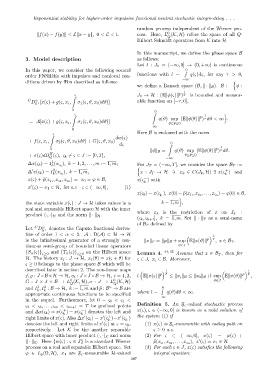
                                                              Let l : J 0 = (−∞, 0] → (0, +∞) is continuous
            In this paper, we consider the following second                        R 0
            order FNSIDEs with impulses and nonlocal con-     functions with l =      q(ς)dς, for any τ > 0,
                                                                                  −∞
            ditions driven by fBm described as follows:                                                  n
                                                              we define a Banach space (B, ∥ · ∥ B ). B :=  ϕ :
                                                                                   1
                                                                                 p
                                  ς                           J 0 → H : (E∥ϕ(ς)∥ ) p  is bounded and measur-
                                 Z
             C   α                                            able function on [−τ, 0],
               D +[x(ς) + g(ς, x ς ,  σ 1 (ς, ϑ, x ϑ )dϑ)]
                 0
                                 0
                                                                      0
                                  ς                                  Z                              o
                                 Z                                                        p  1
                                                                        q(ϑ) sup (E∥ϕ(θ)∥ ) dϑ < ∞ .
                                                                                            p
              = A[x(ς) + g(ς, x ς ,  σ 1 (ς, ϑ, x ϑ )dϑ)]                   ϑ≤θ≤0
                                                                    −∞
                                 0
                        ς                                     Here B is endowed with the norm
                       Z
                                                    dw(ς)
              + f(ς, x ς ,  σ 2 (ς, ϑ, x ϑ )dϑ) + G(ς, ϑ, x ϑ )
                                                      dς                    Z 0
                       0                                                                         p  1
                                                                    ∥ϕ∥ B =    q(ϑ) sup (E∥ϕ(θ)∥ ) dϑ.
                                                                                                   p
                       H
              + σ(ς)dB (ς), ς k ̸= ς ∈ J := [0, T],                        −∞      ϑ≤θ≤0
                       Q
                        1
                        k
             ∆x(ς k ) = I (x ς k  ), k = 1, 2, . . . , m := 1, m;  For J T = (−∞, T], we consider the space B T :=
                                                              n
               ′         2                                                                           +
                        k
                                                                                                     k
             ∆ x(ς k ) = I (x ς k ), k = 1, m,                 x : J T → H ∋ x k ∈ C(J k , H) ∃ x(ς ) and
                                ) = x 0 = φ ∈ B,                 −
                                                                 k
             x(ς) + ˜p(x ς 1  , x ς 2  , x ς n                x(ς ) with
               ′
             x (ς) = x 1 ∈ H, for a.e  ς ∈ (−∞, 0],     (1)
                                                                        −
                                                                        k
                                                              x(ς k ) = x(ς ), x(0) − ˜p(x ς 1 , x ς 2  , . . . , x ς n ) = φ(0) ∈ B,
                                                                                o
            the state variable x(ς) : J → H takes values in a            k = 1, m ,
            real and separable Hilbert space H with the inner
            product ⟨·, ·⟩ H and the norm ∥ · ∥ H .           where x k is the restriction of x on J k      :
                                                              (ς k , ς k+1 ], k = 1, m. Set ∥ · ∥ T as a semi-norm
                                                              of B T defined by
                    α
            Let  C D + denotes the Caputo fractional deriva-
                    0
            tive of order 1 < α < 2. A : D(A) ⊂ H → H                                          1

            is the infinitesimal generator of a strongly con-    ∥x∥ T = ∥φ∥ B + sup E∥x(ϑ)∥ p  p , x ∈ B T .
            tinuous semi-group of bounded linear operators                      ϑ∈J
            {S α (ς)}   and {T α (ς)}  on the Hilbert space               44,45
                    ς≥0            ς≥0                        Lemma 4.         Assume that x ∈ B T , then for
            H. The history x ς : J → H, x ς (θ) = x(ς + θ) for  ς ∈ J, x ς ∈ B. Moreover,
            ς ≥ 0 belongs to the phase space B which will be
            described later in section 2. The non-linear maps             1                                   1

            f, g : J ×B×H → H, σ i : J ×J ×B → H, i = 1, 2,   l E∥x(ς)∥ p  p  ≤ ∥x ς ∥ B ≤ ∥x 0 ∥ B +l sup E∥x(ϑ)∥ p  p  ,
                                0
                                                   0
            G : J × J × B → L (K, H), σ : J → L (K, H)                                          ϑ∈J
                                Q
                                                   Q
                                                  n
                     2
                  1
            and I , I : B → H, k := 1, m and ˜p : B → B are              0
                 k  k                                         where l =  R  q(ϑ)dϑ < ∞.
            appropriate continuous functions to be specified
                                                                       −∞
            in the sequel. Furthermore, let 0 = ς 0 < ς 1 <
            ς 2 < ς 3 , . . . , ς m < ς m+1 = T be prefixed points  Definition 5. An F ς -valued stochastic process
                                     −
                             +
            and ∆x(ς k ) = x(ς ) − x(ς ) denotes the left and  x(ς), ς ∈ (−∞, 0] is known as a mild solution of
                             k       k
                                                 +
                                                         −
                                                      ′
                                               ′
                                      ′
            right limits of x(ς). Also ∆x (ς k ) = x (ς )−x (ς )  the system (1) if
                                                         k
                                                 k
                                              ′
            denotes the left and right limits of x (ς) at ς = ς k ,  (1) x(ς) is F ς -measurable with cadlag path on
            respectively.  Let K be the another separable            ς ≥ 0 a.s.
            Hilbert space with inner product ⟨·, ·⟩ K and norm   (2) For ς    ∈  (−∞, 0], x(ς)    =   φ(ς) +
                                                                                         ′
            ∥ · ∥ K . Here {w(ς) : ς ∈ J} is a standard Wiener       ˜ p(x ς 1  , x ς 2  , . . . , x ς n ), x (ς) = x 1 ∈ H
            process on a real and separable Hilbert space. Set   (3) For each ς ∈ J, x(ς) satisfies the following
            φ ∈ L p (Ω, H), x 1 are F ς -measurable H-valued         integral equation:
                                                           107

