


Page 22 - IJOCTA-15-4
P. 22
M. A. Aman et al. / IJOCTA, Vol.15, No.4, pp.549-577 (2025)
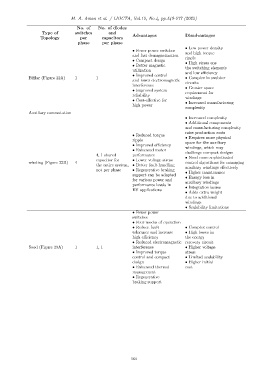
                                   No. of    No. of diodes
                    Type of       switches       and        Advantages             Disadvantages
                   Topology          per      capacitors
                                    phase     per phase
                                                                                   • Low power density
                                                            • Fewer power switches  and high torque
                                                            and fast demagnetization  ripple
                                                            • Compact design       • High stress one
                                                            • Better magnetic      the switching elements
                                                            utilization            and low efficiency
                                                            • Improved control
              Bifilar (Figure 22A)  1       1                                      • Complex in snubber
                                                            and lower electromagnetic  circuits
                                                            interference           • Greater space
                                                            • Improved system      requirement for
                                                            reliability            windings
                                                            • Cost-effective for   • Increased manufacturing
                                                            high power
                                                                                   complexity
              Auxiliary commutation
                                                                                   • Increased complexity
                                                                                   • Additional components
                                                                                   and manufacturing complexity
                                                                                   raise production costs
                                                            • Reduced torque
                                                                                   • Requires more physical
                                                            ripple
                                                                                   space for the auxiliary
                                                            • Improved efficiency
                                                                                   windings, which may
                                                            • Enhanced motor
                                                                                   challenge compact designs
                                            4, 1 shared     performance
                                                                                   • Need more sophisticated
                                            capacitor for   • Lower voltage stress
              winding (Figure 22B)  4                                              control algorithms for managing
                                            the entire system, • Better fault handling
                                                                                   auxiliary windings effectively
                                            not per phase   • Regenerative braking
                                                                                   • Higher maintenance
                                                            support can be adapted
                                                                                   • Energy loss in
                                                            for various power and
                                                                                   auxiliary windings
                                                            performance levels in
                                                                                   • Integration issues
                                                            EV applications
                                                                                   • Adds extra weight
                                                                                   due to additional
                                                                                   windings
                                                                                   • Scalability limitations
                                                            • Fewer power
                                                            switches
                                                            • Four modes of operation
                                                            • Reduce fault         • Complex control
                                                            tolerance and increase  • High losses in
                                                            high efficiency        the energy
                                                            • Reduced electromagnetic recovery circuit
              Sood (Figure 23A)   1         1, 1            interference           • Higher voltage
                                                            • Improved torque      stress
                                                            control and compact    • Limited scalability
                                                            design                 • Higher initial
                                                            • Enhanced thermal     cost
                                                            management
                                                            • Regenerative
                                                            braking support


                                                           564

