


Page 25 - IJOCTA-15-4
P. 25
Control strategies and power converter topologies for switched reluctance motors in electric...
                                  No. of   No. of diodes
                   Type of       switches       and
                                                          Advantages                 Disadvantages
                  Topology          per      capacitors
                                   phase     per phase
                                                          • Reduced switching losses
                                                          and conduction losses
                                                          enhance overall system
                                                          efficiency
                                                          • Reduced torque ripple
                                                          • Compact design requires
                                                          fewer components,
                                                          resulting in a
                                                          lightweight design         • Switching
                                                          • Supports better utilization complexity
                                                          of the DC bus voltage,     • High-speed switching
                                                          enhancing motor speed      may generate significant
                                                          and performance            electromagnetic interference,
                                                          • Cost-effective           requiring additional
              T-type (Figure 25D) 3        2, 1
                                                          • Effectively supports     filtering
                                                          energy recovery during     • Concentration
                                                          braking                    of power
                                                          • Lower power losses       handling in specific
                                                          result in reduced          components may lead to
                                                          heat generation,           localized heating issues
                                                          simplifying cooling
                                                          requirements.
                                                          • Reliable operation
                                                          • Suitable for various
                                                          power levels, making it
                                                          adaptable for
                                                          different EV
                                                          applications
              Abbreviations: AHB: Asymmetric half bridge; DC: Direct current; EV: Electric vehicle;
              NIPC: Novel integrated power converter; SRM: Switched reluctance motor.


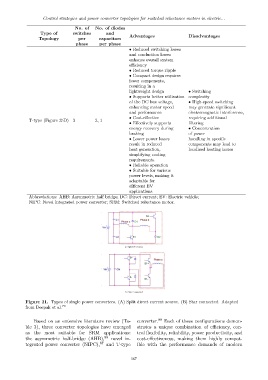
            Figure 21. Types of single power converters. (A) Split direct current source. (B) Star connected. Adapted
            from Deepak et al. 79

                Based on an extensive literature review (Ta-  converter. 88  Each of these configurations demon-
            ble 3), three converter topologies have emerged   strates a unique combination of efficiency, con-
            as the most suitable for SRM applications:        trol flexibility, reliability, power productivity, and
            the asymmetric half-bridge (AHB),  89  novel in-  cost-effectiveness, making them highly compat-
            tegrated power converter (NIPC), 87  and T-type   ible with the performance demands of modern


                                                           567

