


Page 100 - ITPS-7-1
P. 100
INNOSC Theranostics and
            Pharmacological Sciences                                               Plants immunoactivity: In silico study


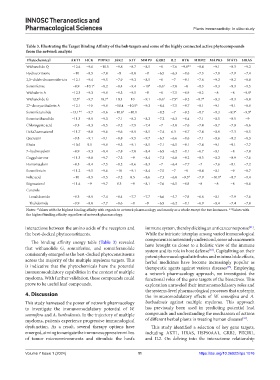
            Table 3. Illustrating the Target Binding Affinity of the hub targets and some of the highly connected active phytocompounds
            from the network analysis
             Phytochemical     AKT1  HCK   PDPK1  JAK2  KIT  MMP9  GRB2   IL2  BTK  MDM2  MAPK3  STAT3  HRAS
            Withanolide Q       −12.4  −9.6  −10.5  −9.8  −8.7  −8.5  −8  −7.6  −9.8**  −8.4  −9.1  −8.3  −9.2
            Hydrocortisone      −10   −8.5  −7.8   −8   −8.8   −8   −6.5  −6.3  −8.6  −7.3  −7.8   −7.9  −7.4
            2,3−didehrdrosomnifericin  −12.1  −9.4  −9.5  −7.9  −9.2  −8.5  −8  −7  −9.1  −7.6  −9.2  −8.2  −8.8
            Somniferine         −8.9  −10.1*  −8.2  −8.4  −9.4  −10*  −8.6*  −7.8  −8  −8.3  −9.3  −9.3  −9.5
            Withaferin A        −12.3  −9.3  −9.9  −9.3  −9.5  −9    −8  −7.5  −8.9  −8.2   −8     −8    −9.9*
            Withanolide G       12.5*  −9.7  10.7*  10.3  10  −9.1  −8.6*  −7.9*  −9.2  −8.7*  −8.3  −8.3  −8.8
            27−deoxywithaferin A  −12.1  −10  −9.9  −10.4  −10.5*  −9.2  −8.4  −7.5  −9.7  −8.1  −9.1  −9.1  −8.9
            Somniferanolide    −13.1**  −9.7  −9.6  −10.6*  −10.1   −8.2  −7   −9.2  −8.7   −9.3  −9.3*  −9.9*
            Somniwithanolide    −11.3  −8.9  −9.3  −7.1  −8.2  −8.2  −7.2  −6.3  −8.4  −7.1  −8.5  −8.5  −9
            Chlorogenic acid    −9.3  −8.3  −8.5  −9.2  −7.9  −7.4   −7  −5.8  −7.6  −7.4   −8.7   −7.8  −8.6
            Delta7avenasterol   −11.7  −8.8  −9.6  −9.6  −8.9  −8.5  −7.4  6.5  −8.7  −7.4  −8.9   −7.3  −8.5
            Quercetin           −9.8  −9.1  −9.1  −8.8  −9.5  −9.7  −6.7  −6.6  −8.6  −7.1  −8.6   −8.2  −8.3
            Rhein               −10.5  9.1  −9.9  −9.3  −9.1  −8.5  −7.1  −6.5  −9.1  −7.4  −9.1   −9.1  −7.7
            7−hydroxyaloin      −8.9  −9.3  −8.4  −7.8  −7.8  −8.4  −6.9  −6.2  −8.1  −6.7  −8.1   −8    −7.8
            Guggulsterone       −11.3  −8.8  −9.7  −7.3  −9   −8.4  −7.3  −6.8  −9.2  −8.3  −8.2   −8.9  −7.6
            Homonataloin        −8.5  −8.4  −7.5  −8.2  −8.6  −8.3   −7  −6.4  −7.7  −7     −7.6   −8.1  −7.2
            Somnifericin        −11.2  −9.5  −9.6  −10  −9.1  −8.4  −7.5  −7   −9    −8.4   −8.1   −9    −8.7
            Folic acid          −10   −8.9  −9.5  −9.2   8.5  −8.6  −7.3  −6.8  −9.3*  −7.9  −10.1*  −8.7  −9.4
            Stigmasterol        −11.4  −9   −9.7   9.3   −9   −8.1  −7.6  −6.5  −8.8  −8    −8     −8    −8.6
            Controls
             Lenalidomide       −9.3  −8.9  −7.4  −8.4  −7.7  −7.7  −6.6  −5.7  −7.8  −6.6  −8.1   −7.9  −7.6
             Thalidomide        −9.9  −8.8  −7.7  −8.6   −8    −9   −6.9  −6.2  −8.1  −6.9  −8.4   −7.4  −7.8
            Notes: *Values with the highest binding affinity with regards to network pharmacology and mostly as a whole except the two instances. **Values with
            the highest binding affinity regardless of network pharmacology.


            interactions between the amino acids of the receptors and   immune system, thereby eliciting an anticancer response .
                                                                                                           [41]
            the best-docked phytoconstituents.                 While the intricate interplay among varied immunological
                                                               components is not entirely understood, some advancements
              The binding affinity energy table (Table  3) revealed   have brought us closer to a holistic view of the immune
            that withanolide G, somniferine, and somniferanolide   system and its role in host defense . Capitalizing on their
                                                                                          [42]
            consistently emerged as the best-docked phytoconstituents   potent pharmacological attributes and minimal side effects,
            across the majority of the multiple myeloma targets. This   herbal medicines have become increasingly popular as
            is indicative that the phytochemicals have the potential   therapeutic agents against various diseases . Employing
                                                                                                  [43]
            immunomodulatory capabilities in the context of multiple   a network pharmacology approach, we investigated the
            myeloma. With further validation, these compounds could   functional roles of the gene targets of the bioactives. This
            prove to be useful lead compounds.                 exploration unraveled their immunomodulatory roles and
                                                               the systems-level pharmacological processes that underpin
            4. Discussion                                      the immunomodulatory effects of  W. somnifera  and  A.

            This study harnessed the power of network pharmacology   barbadensis  against  multiple  myeloma.  This approach
            to investigate the immunomodulatory potential of  W.   has previously been used in predicting potential lead
            somnifera and A. barbadensis. In the trajectory of multiple   compounds and understanding the mechanism of actions
                                                                                                        [31]
            myeloma, patients experience progressive immunological   of different herbal plants in treating human diseases .
            dysfunction. As a result, several therapy options have   This study identified a selection of key gene targets,
            emerged, aiming to navigate the immunosuppressive milieu   including AKT1, HRAS, HSP90AA1, GRB2, PIK3R1,
            of tumor microenvironments and stimulate the host’s   and IL2. On delving into the interactome relationship


            Volume 7 Issue 1 (2024)                         11                        https://doi.org/10.36922/itps.1076

