


Page 73 - ITPS-7-1
P. 73
INNOSC Theranostics and
            Pharmacological Sciences                                     Docking study of quinoline-3-carbaldehyde derives


            interactions can lead to toxic or adverse effects due to   clinically utilized drugs, involving the addition or removal
            decreased drug clearance or the accumulation of drugs or   of specific functional groups through hydroxylation,
            their metabolites. Table 6 reveals that the lead compounds   demethylation, and dealkylation processes .
                                                                                                 [27]
            act as inhibitors of CYP2C19 while serving as substrates
            for CYP2D6. These cytochromes play crucial roles in the   3.4. Bioactivity score
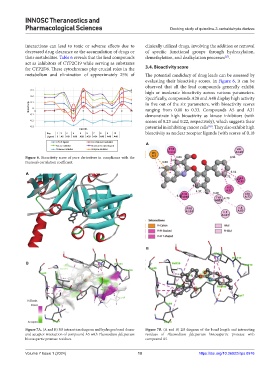
            metabolism and elimination of approximately 25% of   The potential candidacy of drug leads can be assessed by
                                                               evaluating their bioactivity scores. In Figure 6, it can be
                                                               observed that all the lead compounds generally exhibit
              0.3
                                                               high or moderate bioactivity across various parameters.
              0.2
                                                               Specifically, compounds A20 and A48 display high activity
              0.1
             Bioactivity  0                                    in five out of the six parameters, with bioactivity scores
                                                               ranging from 0.00 to 0.33. Compounds A5 and A31
              -0.1  0  1  2  3  4   5   6   7   8    9  10     demonstrate high bioactivity as kinase inhibitors (with
              -0.2                                             scores of 0.23 and 0.22, respectively), which suggests their
                                                                                         [28]
              -0.3                                             potential in inhibiting cancer cells . They also exhibit high
                                   Ligands
                     Key   1  2  3  4  5  6  7  8  9  10       bioactivity as nuclear receptor ligands (with scores of 0.18
                     Ligand  5  A5  A31  A36  A20  A33  A34  A45  A48  A49
                         GPCR ligand    Ion channel modulator  A
                         Kinase inhibitor  Nuclear receptor ligand
                         Protease inhibitor  Enzyme inhibitor
            Figure 6. Bioactivity score of pure derivatives in compliance with the
            Pearson’s correlation coefficient.

            A


                                                               B


            B


            Figure 7A. (A and B) 3D interaction diagram and hydrogen bond donor   Figure 7B. (A and B) 2D diagram of the bond length and interacting
            and acceptor interaction of compound A5 with Plasmodium falciparum   residues of  Plasmodium  falciparum  histoaspartic  protease with
            histoaspartic protease residues.                   compound A5.


            Volume 7 Issue 1 (2024)                         10                        https://doi.org/10.36922/itps.0976

