


Page 72 - ITPS-7-1
P. 72
INNOSC Theranostics and
            Pharmacological Sciences                                     Docking study of quinoline-3-carbaldehyde derives


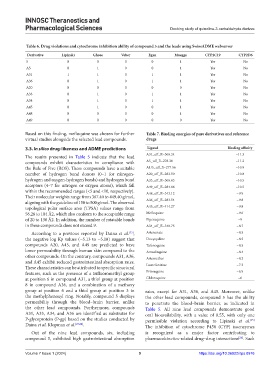
            Table 6. Drug violations and cytochrome inhibition ability of compound 5 and the leads using SwissADME webserver
             Derivative    Lipinski      Ghose       Veber      Egan       Muegge       CYP2C19        CYP2D6
            5                 0           0           0          0            1            Yes           No
            A5                0           1           0          0            1            Yes           No
            A31               1           1           0          1            1            Yes           No
            A36               0           1           0          1            1            Yes           No
            A20               0           0           0          0            0            Yes           No
            A33               0           1           0          1            1            Yes           No
            A34               0           1           0          1            1            Yes           No
            A45               0           1           0          0            1            Yes           No
            A48               0           0           0          0            1            Yes           No
            A49               0           0           0          0            0            Yes           No


            Based on this finding, mefloquine was chosen for further   Table 7. Binding energies of pure derivatives and reference
            virtual studies alongside the selected lead compounds.  drugs

            3.3. In silico drug-likeness and ADME predictions   Ligand                            Binding affinity
            The  results  presented  in  Table  5  indicate  that  the  lead   A31_uff_E=300.34      −11.3
            compounds exhibit characteristics in compliance with   A5_uff_E=278.30                   −11.2
            the Rule of Five (RO5). These compounds have a suitable   A1/5_uff_E=277.56              −10.9
            number of hydrogen bond donors (0–1 for nitrogen-  A20_uff_E=282.50                      −10.8
            hydrogen and oxygen-hydrogen bonds) and hydrogen bond   A33_uff_E=300.83                 −10.5
            acceptors (4–7 for nitrogen or oxygen atoms), which fall   A49_uff_E=284.88              −10.5
            within the recommended ranges (<5 and <10, respectively).   A48_uff_E=343.12              −9.9
            Their molecular weights range from 367.40 to 449.40 g/mol,   A36_uff_E=283.54             −9.8
            aligning with the guideline of 150 to 500 g/mol. The observed
            topological polar surface area (TPSA) values range from   A45_uff_E=414.27                −9.8
            56.26 to 104 Å2, which also conform to the acceptable range   Mefloquine                  −9.6
            of 20 to 130 Å2. In addition, the number of rotatable bonds   Piperaquine                 −9
            in these compounds does not exceed 9.              A34_uff_E=340.75                       −8.7
              According to a previous reported by Daina  et al. ,   Artesunate                        −8.5
                                                        [23]
            the negative log Kp values (−5.13 to −5.18) suggest that   Doxycycline                    −8.5
            compounds A20, A45, and A49 are predicted to have   Tafenoquine                           −8.5
            lower permeability through human skin compared to the   Amodiaquine                       −8.4
            other compounds. On the contrary, compounds A31, A36,   Artemether                        −8.3
            and A45 exhibit reduced gastrointestinal absorption rates.
            These characteristics can be attributed to specific structural   Lumefantrine             −7.3
            features, such as the presence of a trifluoromethyl group   Primaquine                    −6.9
            at position 6 in compound A31, a thiol group at position   Chloroquine                    −6
            8 in compound A36, and a combination of a methoxy
            group at position 6 and a thiol group at position 3 in   rates, except for A31, A36, and A45. Moreover, unlike
            the methylphenoxyl ring. Notably, compound 5 displays   the other lead compounds, compound 5 has the ability
            permeability through the blood–brain barrier, unlike   to penetrate the blood–brain barrier, as indicated in
            the other lead compounds. Furthermore, compounds   Table 5. All nine lead compounds demonstrate  good
            A31, A33,  A34, and A36 are identified  as  substrates  for   oral bioavailability, with a value of 0.55, with only one
            P-glycoprotein (P-gp) based on the studies conducted by   permissible violation according to Lipinski  et al.
                                                                                                           [25]
            Daina et al. Klopman et al. [23,24] .              The inhibition of cytochrome P450 (CYP) isoenzymes
              Out of the nine lead compounds, six, including   is  recognized  as  a  major  factor  contributing  to
            compound 5, exhibited high gastrointestinal absorption   pharmacokinetics-related drug–drug interactions . Such
                                                                                                      [26]

            Volume 7 Issue 1 (2024)                         9                         https://doi.org/10.36922/itps.0976

