


Page 71 - ITPS-7-1
P. 71
INNOSC Theranostics and
            Pharmacological Sciences                                     Docking study of quinoline-3-carbaldehyde derives


            3.2. Toxicity results of compound (5), hypothetical   Notably, compound 5 and forty-one of the hypothetical
            compounds (A1–A50), and ten antimalarial           derivatives exhibited failures in one or more of these tests,
            reference drugs                                    suggesting potential toxic and carcinogenic activities .
                                                                                                           [22]
            A total of 50 hypothetical compounds (A1–A50) depicted   However, nine lead compounds (A5, A20, A31, A33, A34,
            in  Figure  5,  along  with  ten reference drugs  (artesunate,   A36, A45, A48, and A49) shown in Figure 3 demonstrated
            doxycycline, tafenoquine, amodiaquine, arthemeter,   full compliance with the evaluated toxicity parameters
            lumefantrine, primaquine, piperaquine, mefloquine, and   (Tables 1 and 2).
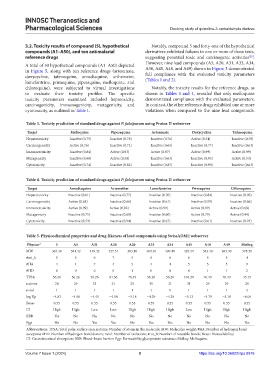
            chloroquine), were subjected to virtual investigations   Notably, the toxicity results for the reference drugs, as
            to  evaluate  their  toxicity  profiles. The  specific   shown in Tables 3 and 4, revealed that only mefloquine
            toxicity parameters  examined included hepatoxicity,   demonstrated compliance with the evaluated parameters.
            carcinogenicity, immunogenicity, mutagenicity, and   In contrast, the other reference drugs exhibited one or more
            cytotoxicity, as outlined in Table 1.              violations when compared to the nine lead compounds.


            Table 3. Toxicity prediction of standard drugs against P. falciparum using Protox II webserver
             Target            Mefloquine       Piperaquine      Artesunate        Doxycycline      Tafenoquine
            Hepatotoxicity     Inactive (0.75)  Inactive (0.78)  Inactive (0.76)  Active (0.54)     Inactive (0.78)
            Carcinogenicity    Active (0.76)    Inactive (0.71)  Inactive (0.65)  Inactive (0.77)   Inactive (0.63)
            Immunotoxicity     Inactive (0.84)  Active (0.93)    Active (0.87)    Active (0.99)     Active (0.99)
            Mutagenicity       Inactive (0.68)  Active (0.50)    Inactive (0.63)  Inactive (0.95)   Active (0.54)
            Cytotoxicity       Inactive (0.74)  Inactive (0.82)  Inactive (0.87)  Inactive (0.90)   Inactive (0.63)


            Table 4. Toxicity prediction of standard drugs against P. falciparum using Protox II webserver
             Target            Amodiaquine      Artemether       Lumefantrine     Primaquine       Chloroquine
            Hepatotoxicity    Inactive (0.61)   Inactive (0.77)  Inactive (0.70)  Inactive (0.84)  Inactive (0.90)
            Carcinogenicity   Active (0.61)     Inactive (0.66)  Inactive (0.61)  Inactive (0.59)  Inactive (0.66)
            Immunotoxicity    Active (0.99)     Active (0.92)   Active (0.99)     Active (0.99)    Active (0.69)
            Mutagenicity      Inactive (0.75)   Inactive (0.60)  Inactive (0.60)  Active (0.79)    Active (0.94)
            Cytotoxicity      Inactive (0.53)   Inactive (0.94)  Inactive (0.67)  Inactive (0.61)  Inactive (0.93)


            Table 5. Physicochemical properties and drug‑likeness of lead compounds using SwissADME webserver
             Physico*    5      A5      A31     A36     A20     A33     A34     A45     A48     A49     Mefloq
            MW         367.40  381.42  449.42  427.51  383.40  409.48  409.48  429.49  383.40  383.40   378.31
            #rot_b       5       5       6       7       5       6       6       6       5       5        4
            #HA          4       4       7       4       5       4       4       5       5       5        9
            #HD          0       0       0       0       1       0       0       0       1       1        2
            TPSA       56.26    56.26   56.26   81.56   76.49   56.26   56.26  104.29   76.49   76.49   45.15
            natoms      28      29      33       31      29      31      31      31      29      29      26
            nviol        1       1       1       1       1       1       1       1       1       1        2
            log Kp     −4.83   −4.66   −4.45   −4.58   −5.18    −4.29   −4.29   −5.13   −4.79   −5.18   −6.04
            Bioav       0.55    0.55    0.55    0.55    0.55    0.55    0.55    0.55    0.55    0.55     0.55
            GI          High    High    Low     Low     High    High    High    Low     High    High    High
            BBB         Yes     No      No      No      No      No      No      No      No      No       No
            Pgp         No      No      Yes     Yes     No      Yes     Yes     No      No      No       Yes
            Abbreviations: TPSA: Total polar surface area; natoms: Number of atoms in the molecule; MW: Molecular weight; #HA: Number of hydrogen bond
            acceptors; #HD: Number of hydrogen bond donors; nviol: Number of violations; #rot_b: Number of rotatable bonds; bioav: Bioavailability;
            GI: Gastrointestinal absorption; BBB: Blood–brain barrier; Pgp: Permeability glycoprotein substrate; Mefloq: Mefloquine.


            Volume 7 Issue 1 (2024)                         8                         https://doi.org/10.36922/itps.0976

