


Page 87 - ITPS-7-1
P. 87
INNOSC Theranostics and
            Pharmacological Sciences                                                PfHSP and polyamines interactions


                          A                                  B


                          C                                  D


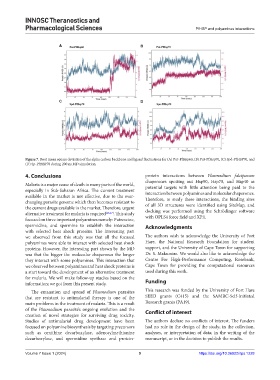
            Figure 7. Root mean square deviation of the alpha carbon backbone and ligand fluctuations for (A) Put-PfHsp60, (B) Put-PfHsp70, (C) Spd-PfHSP70, and
            (D) Sp-PfHSP70 during 200 ns MD simulation.

            4. Conclusions                                     protein interactions between  Plasmodium falciparum
                                                               chaperones spotting out Hsp90, Hsp70, and Hsp40 as
            Malaria is a major cause of death in many parts of the world,   potential targets with little attention being paid to the
            especially in Sub-Saharan Africa. The current  treatment   interaction between polyamines and molecular chaperones.
            available in the market is not effective, due to the ever-
            changing parasite genome which then becomes resistant to   Therefore, to study these interactions, the binding sites
                                                               of all 3D structures were identified using SiteMap, and
            the current drugs available in the market. Therefore, urgent
            alternative treatment for malaria is required [26,27] . This study   docking was performed using the Schrödinger software
            focused on three important polyamines namely: Putrescine,   with OPLS4 force field and XP.1.
            spermidine, and spermine to establish the interaction   Acknowledgments
            with selected heat shock proteins. The interesting part
            we observed from this study was that all the  focused   The authors wish to acknowledge the University of Fort
            polyamines were able to interact with selected heat shock   Hare, the National Research Foundation for student
            proteins. However, the interesting part shown by the MD   support, and the University of Cape Town for supporting
            was that the bigger the molecular chaperones the longer   Dr. S. Makumire. We would also like to acknowledge the
            they interact with some polyamines. This interaction that   Centre For High-Performance Computing, Rosebank,
            we observed between polyamines and heat shock proteins is   Cape Town for providing the computational resources
            a start toward the development of an alternative treatment   used during this work.
            for malaria. We will make follow-up studies based on the
            information; we got from this present study.       Funding

              The emanation and spread of  Plasmodium parasites   This research was funded by the University of Fort Hare
            that are resistant to antimalarial therapy is one  of the   SEED grants (C415) and the SAMRC-Self-Initiated
            main problems in the treatment of malaria. This is a result   Research grants (PA19).
            of  the  Plasmodium  parasite’s  ongoing  evolution  and  the   Conflict of interest
            creation of novel strategies for surviving drug toxicity.
            Studies of antimalarial drug development have been   The authors declare no conflicts of interest. The funders
            focused on polyamine biosynthesis by targeting precursors   had no role in the design of the study; in the collection,
            such as ornithine decarboxylase, adenosylmethionine   analyses, or interpretation of data; in the writing of the
            decarboxylase, and spermidine synthase and protein-  manuscript, or in the decision to publish the results.


            Volume 7 Issue 1 (2024)                         9                         https://doi.org/10.36922/itps.1228

