


Page 48 - JCTR-10-3
P. 48
222                       Das et al. | Journal of Clinical and Translational Research 2024; 10(3): 219-228
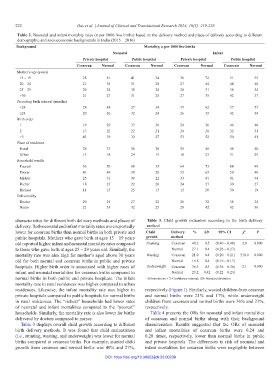
        Table 2. Neonatal and infant mortality rates (n per 1000 live births) based on the delivery method and place of delivery according to different
        demographic and socioeconomic backgrounds in India (2015 – 2016)
        Background                                            Mortality, n per 1000 live births
                                                 Neonatal                                   Infant
                                    Private hospital     Public hospital      Private hospital     Public hospital
                                  Cesarean   Normal   Cesarean   Normal    Cesarean   Normal    Cesarean   Normal
        Mother’s age (years)
         15 – 19                    28        61         41        34         36        72         51        55
         20 – 24                    21        35         31        28         27        44         44        40
         25 – 29                    20        24         30        24         26        31         38        34
         >30                        21        27         31        25         27        35         42        37
        Preceding birth interval (months)
         <24                        28        48         27        34         37        62         37        53
         ≥24                        20        26         32        24         26        33         42        34
        Birth order
         1                          19        29         37        30         24        36         46        40
         2                          17        22         22        21         24        28         32        31
         >3                         43        39         32        27         53        52         50        41
        Place of residence
         Rural                      28        37         36        28         35        46         48        40
         Urban                      13        18         24        19         18        23         31        29
        Household wealth
         Poorest                    56        59         60        35         64        73         84        49
         Poorer                     41        49         38        28         53        63         50        40
         Middle                     25        31         30        22         33        41         41        34
         Richer                     18        23         22        20         24        27         30        27
         Richest                    11        15         25        13         15        20         30        19
        Delivered by
         Doctor                     20        25         27        25         26        32         38        34
         Nurse                      21        33         32        25         28        42         42        36


        characteristics for different birth delivery methods and places of   Table  3. Child growth indicators according to the birth delivery
        delivery. Both neonatal and infant mortality rates were reportedly   method
        lower for cesarean births than normal births in both private and   Child   Delivery   %  SD  95% CI  χ 2  P
        public hospitals. Mothers who gave birth at ages 15 – 19 years   growth  method
        old reported higher infant and neonatal mortality rates compared   Stunting  Cesarean  40.2  0.5  (0.40 – 0.40)  2.0  0.000
        to those who gave birth at ages 25 – 29 years old. Similarly, the   Normal   27.1  0.4  (0.26 – 0.27)
        mortality rate was also high for mother’s aged above 30 years   Wasting  Cesarean   21.0  0.4  (0.20 – 0.21)  310.0  0.000
        old for both normal and cesarean births in public and private     Normal   16.8  0.4  (0.16 – 0.17)
        hospitals. Higher birth order is associated with higher rates of   Underweight  Cesarean   36.3  0.5  (0.36 – 0.36)  2.1  0.000
        infant and neonatal mortalities for cesarean births compared to   Normal   23.2  0.42  (0.22 – 0.23)
        normal births in both public and private hospitals. The infant   Abbreviations: CI: Confidence interval; SD: Standard deviation.
        mortality rate in rural residences was higher compared to urban
        residences. Likewise, the infant mortality  rate was  higher in   respectively (Figure 1). Similarly, wasted children from cesarean
        private hospitals compared to public hospitals for normal births   and normal  births were 21% and 17%, while  underweight
        in rural residences. The “richest” households had lower rates   children from cesarean and normal births were 36% and 23%,
        of neonatal  and  infant  mortalities  compared  to  the  “poorest”   respectively.
        households. Similarly, the mortality rate is also lower for births   Table 4 presents the ORs for neonatal and infant mortalities
        delivered by doctors compared to nurses.               of cesarean  and normal  births along  with their  background
          Table 3 displays overall child growth according to different   characteristics.  Results suggested that the ORs of neonatal
        birth delivery methods. It was found that child malnutrition   and infant  mortalities  of cesarean  births were 0.24 and
        (i.e., stunting, wasting, and underweight) was lower for normal   0.28  times, respectively, lower than normal births in public
        births compared to cesarean births. For example, stunted child   and private hospitals. The differences in risk of neonatal and
        growth from cesarean and normal births was  40% and 27%,   infant mortalities for cesarean births were negligible between

                                              DOI: https://doi.org/10.36922/jctr.22.00239

