


Page 47 - JCTR-10-3
P. 47
Das et al. | Journal of Clinical and Translational Research 2024; 10(3): 219-228   221
        growth. The  life-table technique was  developed to estimate   birth more than 24 months after a preceding birth were more
        neonatal  and infant  mortality  rates based on birth history   inclined  toward cesarean  section than those who had given
        variables  collected  from the Child Mortality  Census dataset.   birth less than 24 months after a preceding birth. Interestingly,
        Binary logistic regression models were used to identify the odds   birth order was negatively  correlated  with cesarean  section
        of normal and cesarean delivery. Childbirth through cesarean   and positively correlated with normal delivery. This could be
        section and normal delivery were coded as 1 and 0, respectively.   associated  with Muslim families who prefer normal delivery
        Following the collection of bivariate data, multivariate logistic   over cesarean section. Cesarean sections were reportedly more
        regression models were constructed for each of the dependent   common in urban residences compared to rural residences
        variables. The results of the regression analysis were presented as   (42.0% vs. 35.5%) due to the availability and accessibility of
        odds ratios (OR), along with the corresponding 95% confidence   medical  facilities and transportation.  Household wealth plays
        intervals  (CIs). All statistical  analyses were performed using   a dominant role in determining the birth delivery method. The
        STATA  software (version 15.0).                        “richest”  households would prefer cesarean  birth more than
              ®
        3. Results                                             the “poorest” households (43.8% vs. 24.3%, respectively). The
                                                               differences between normal and cesarean births in the “richest”
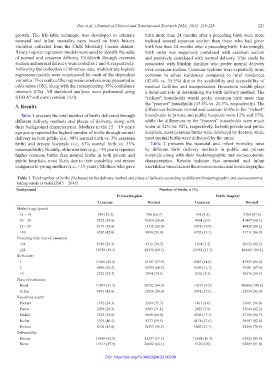
          Table 1 presents the total number of births delivered through   households in private and public hospitals were 12% and 57%,
        different delivery methods and places of delivery, along with   while the differences in the “poorest” households were much
        their background characteristics. Mothers in the 15 – 19 years   wider at 52% vs. 92%, respectively. In both private and public
        age group reported the highest number of births through normal   hospitals, most cesarean births were delivered by doctors, while
        delivery in both public (i.e., 98% normal birth vs. 3% cesarean   most normal births were delivered by the nurse.
        birth) and private hospitals (i.e., 67% normal birth vs. 33%   Table  2  presents the  neonatal  and  infant  mortality  rates
        cesarean birth). Notably, older mothers (e.g., >30 years) reported   by  different  birth  delivery  methods  in  public  and  private
        higher cesarean births than normal births in both private and   hospitals along with their biodemographic and socioeconomic
        public hospitals, most likely due to their capability and means   characteristics.  Results  indicate  that  neonatal  and infant
        compared to young mothers (i.e., <19 years). Mothers who gave   mortalities varied across the socioeconomic and biodemographic

        Table 1. Total number of births (%) based on the delivery method and place of delivery according to different biodemographic and socioeconomic
        backgrounds in India (2015 – 2016)
        Background                                                   Number of births, n (%)
                                                   Private hospital                          Public hospital
                                           Cesarean             Normal              Cesarean             Normal
        Mother’s age (years)
         15 – 19                           399 (33.3)          798 (66.7)           391 (3.4)            3764 (97.6)
         20 – 24                          5525 (34.6)         10424 (65.4)          4564 (9.9)          41497 (90.1)
         25 – 29                          8179 (38.0)         13338 (62.0)          5891 (10.8)         48428 (89.2)
         >30                              6585 (42.0)          9090 (58.0)          4782 (13.1)         31711 (86.9)
        Preceding birth interval (months)
         <24                              1950 (29.3)          4712 (70.7)          1674 (7.5)          20553 (92.5)
         ≥24                              18738 (39.3)        28938 (60.7)         13954 (11.7)         104847 (88.3)
        Birth order
         1                                11066 (42.1)        15197 (57.9)          8067 (14.0)         47923 (86.0)
         2                                6899 (39.5)         10559 (60.5)          5399 (12.1)         39201 (87.9)
         >3                               2723 (25.7)          7894 (74.3)          2162 (5.3)          38276 (94.7)
        Place of residences
         Rural                            11307 (35.5)        20712 (64.5)          10197 (9.2)         100062 (90.8)
         Urban                            9381 (42.0)         12938 (58.0)          5431 (17.6)         25338 (82.4)
        Household wealth
         Poorest                          1102 (24.3)          3249 (75.7)          1417 (4.0)          33661 (96.0)
         Poorer                           2034 (28.9)          4983 (71.1)          2822 (7.8)          33546 (92.2)
         Middle                           3745 (36.0)          6648 (64.0)          4208 (13.3)         27386 (86.7)
         Richer                           5703 (40.5)          8377 (59.5)          4178 (17.6)         19597 (82.4)
         Richest                          8104 (43.8)         10393 (56.2)          3003 (21.1)         11210 (78.9)
        Delivered by
         Doctor                           18509 (42.3)        25237 (57.7)         13184 (16.3)         67825 (88.9)
         Nurse                            11613 (35.9)        20662 (64.1)          9126 (9.0)          92869 (91.0)

                                              DOI: https://doi.org/10.36922/jctr.22.00239

