


Page 93 - OR-1-1
P. 93
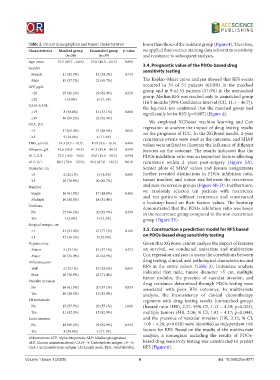
Table 2. Patient demographics and tumor characteristics  lower than those of the resistant group (Figure 4). Therefore,
             Characteristics  Matched group   Unmatched group   p‑value  we applied fluorescence staining data relevant to sensitivity
                             (n=26)        (n=35)             and resistance to subsequent analyses.
             Age, years   57.5 (49.7 – 62.6)  57.6 (48.3 – 62.5)  0.891
             Gender                                           3.4. Prognostic value of the PDOs-based drug
                                                              sensitivity testing
              Female        11 (42.3%)    12 (34.3%)  0.710
              Male          15 (57.7%)    23 (65.7%)          The Kaplan–Meier curve analysis showed that RFS events
             AFP, μg/L                                        occurred in 34 of 54  patients (63.0%) in the matched
              <20           25 (96.2%)    29 (82.9%)  0.228   group and in 9 of 53 patients (17.0%) in the unmatched
                                                              group. Median RFS was reached only in unmatched group
              ≥20           1 (3.8%)      6 (17.1%)           (16.5 months [95% Confidence interval (CI), 11.1 – 46.7]),
             CA19-9, U/L                                      the log-rank test confirmed that the matched group had
              <19           8 (30.8%)     13 (37.1%)  0.806   significantly better RFS (p=0.007) (Figure 4).
              ≥19           18 (69.2%)    22 (62.9%)
                                                                We employed XGBoost machine learning and Cox
             CEA, U/L                                         regression to analyze the impact of drug testing results
              <5            17 (65.4%)    31 (88.6%)  0.061   on the prognosis of ICC. In the XGBoost model, 2-year
              ≥5            9 (34.6%)     4 (11.4%)           recurrence events were used as the outcome, and SHAP
             TBIL, μmol/L  14.3 (9.5 – 18.5)  10.9 (9.6 – 16.6)  0.406  values were utilized to illustrate the influence of different
             Albumin, g/L  42.6 (39.9 – 44.3)  41.3 (39.4 – 44.5)  0.599  features on the outcome. The results indicated that the
             ALT, U/L     27.5 (18.0 – 54.0)  25.0 (14.0 – 59.5)  0.594  PDOs inhibition ratio was an important feature affecting
             ALP, U/L    89.5 (79.0 – 127.0)  92.0 (67.0 – 122.5)  0.610  recurrence within 2  years post-surgery (Figure  5A).
             Diameter, cm                                     Scatter plots of SHAP values and feature assignments
              <5            6 (23.1%)     5 (14.3%)   0.585   further revealed distinctions in PDOs inhibition ratio,
              ≥5            20 (76.9%)    30 (85.7%)          tumor number, and tumor size between the recurrence
             Number                                           and non-recurrence groups (Figure 5B-D). Furthermore,
              Single        16 (61.5%)    17 (48.6%)  0.456   we  randomly selected ten patients with  recurrence
                                                              and ten patients without recurrence and constructed
              Multiple      10 (38.5%)    18 (51.4%)          a heatmap based on their feature values. The heatmap
             Cirrhosis                                        demonstrated that the PDOs inhibition ratio was lower
              No            25 (96.2%)    30 (85.7%)  0.358   in the recurrence group compared to the non-recurrence
              Yes           1 (3.8%)      5 (14.3%)           group (Figure 5E).
             Surgical margin, cm
              <1            14 (53.8%)    27 (77.1%)  0.101   3.5. Construction a prediction model for RFS based
              ≥1            12 (46.2%)    8 (22.9%)           on PDOs-based drug sensitivity testing
             Hepatectomy                                      Given that XGBoost cannot analyze the impact of features
              Minor         6 (23.1%)     13 (37.1%)  0.372   on survival, we conducted univariate and multivariate
              Major         20 (76.9%)    22 (62.9%)          Cox regression analyses to assess the correlations between
             Differentiation                                  drug testing, clinical, and pathological characteristics and
              Well          6 (23.1%)     10 (28.6%)  0.851   RFS  in the  entire  cohort (Table  3).  Univariate analysis
                                                              indicated that male, tumor diameter >5  cm, multiple
              Poor          20 (76.9%)    25 (71.4%)          tumor  nodules,  the  presence  of  vascular  invasion,  and
             Vascular invasion                                drug resistance determined through PDOs testing were
              No            16 (61.5%)    20 (57.1%)  0.935   associated with poor RFS outcomes. In multivariate
              Yes           10 (38.5%)    15 (42.9%)          analysis, the inconsistency of clinical chemotherapy
             LN metastasis                                    regimens  with drug  testing results (unmatched  group)
              No            15 (57.7%)    20 (57.1%)  1.000   (hazard ratio (HR), 2.27; 95% CI, 1.12 – 4.59; p=0.023),
              Yes           11 (42.3%)    15 (42.9%)          multiple tumors (HR, 2.06; % CI, 1.02 – 4.17; p=0.044),
             Local invasion                                   and  the  presence  of  vascular  invasion  (HR,  2.15;  %  CI,
              No            18 (69.2%)    29 (82.9%)  0.345   1.08 – 4.26; p=0.028) were identified as independent risk
              Yes           8 (30.8%)     6 (17.1%)           factors for RFS. Based on the results of the multivariate
             Abbreviations: AFP: Alpha-fetoprotein; ALP: Alkaline phosphatase;    analysis, a nomogram including the results of PDOs-
             ALT: Alanine aminotransferase; CA19 – 9: Carbohydrate antigen  19 – 9;   based drug sensitivity testing was constructed to predict
             CEA: Carcinoembryonic antigen; LN: Lymph node; TBIL: Total bilirubin.  RFS (Figure 6).

            Volume 1 Issue 1 (2025)                         6                                 doi: 10.36922/or.8571

