


Page 111 - OR-1-3
P. 111
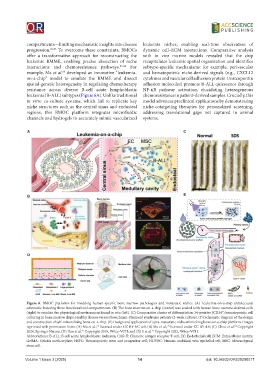
compartments—limiting mechanistic insights into disease   leukemia niches, enabling real-time observation of
            progression. 81,82  To overcome these constraints, BMOCs   dynamic cell–ECM interactions. Comparative analysis
            offer a transformative approach for reconstructing the   with  in vivo murine models revealed that the chip
            leukemic BMME, enabling precise dissection of niche   recapitulates leukemic spatial organization and identifies
            interactions and chemoresistance pathways. 83-86  For   subtype-specific mechanisms: for example, perivascular
            example, Ma et al.  developed an innovative “leukemia-  and hematopoietic niche-derived signals (e.g., CXCL12
                            63
            on-a-chip” model to emulate the BMME and dissect   cytokines and vascular cell adhesion protein 1/osteopontin
            spatial-genetic heterogeneity in regulating chemotherapy   adhesion molecules) promote B-ALL quiescence through
            resistance across diverse B-cell acute lymphoblastic   NF-κB pathway activation, elucidating heterogeneous
            leukemia (B-ALL) subtypes (Figure 6A). Unlike traditional   chemoresistance in patient-derived samples. Crucially, this
            in vitro co-culture systems, which fail to replicate key   model advances preclinical applications by demonstrating
            niche structures such as the central sinus and endosteal   niche-cotargeting therapies for personalized screening,
            regions, this BMOC platform integrates microfluidic   addressing translational gaps not captured in animal
            channels and hydrogels to accurately mimic vascularized   systems.


             A                                                                 C


             B                                                                 E


             D


            Figure  6.  BMOC platforms for modeling human-specific bone marrow pathologies and metastatic niches. (A) Leukemia-on-a-chip architectural
            schematic featuring three functionalized compartments. (B) The bone marrow-on-a-chip (center) was seeded with human bone marrow-derived cells
            (right) to emulate the physiological environment found in vivo (left). (C) Comparative cluster of differentiation 34-positive (CD34 ) hematopoietic cell
                                                                                               +
            culturing in bone marrow chips: Healthy donors versus Shwachman-Diamond syndrome patients (2-week culture). (D) Schematic diagram of the design
            and construction of self-mineralizing bone-on-a-chip. (E) Design and application of a pre-metastatic niche-mimicking bone-on-a-chip platform. Images
            reprinted with permission from: (A) Ma et al.,  licensed under CC BY-NC 4.0; (B) Ma et al.,  licensed under CC BY 4.0; (C) Chou et al.  Copyright
                                                                        70
                                          63
                                                                                                     64
            2020, Springer Nature; (D) Hao et al.  Copyright 2018, Wiley-VCH; and (E) Ji et al.  Copyright 2023, Wiley-VCH.
                                                                  71
                                    61
            Abbreviations: B-ALL: B-cell acute lymphoblastic leukemia; CAR-T: Chimeric antigen receptor T-cell; EC: Endothelial cell; ECM: Extracellular matrix;
            GelMA: Gelatin methacrylate; HSPC: Hematopoietic stem and progenitor cell; HUVEC: Human umbilical vein epithelial cell; MSC: Mesenchymal
            stem cell.
            Volume 1 Issue 3 (2025)                         14                           doi: 10.36922/OR025200017

