


Page 107 - OR-1-3
P. 107
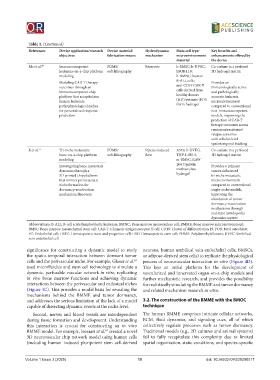
Table 1. (Continued)
             References   Device application/research  Device material/  Hydrodynamic   Main cell type/  Key benefits and
                          objectives           fabrication means  mechanism  microenvironment   enhancements offered by
                                                                            material       the device
             Ma et al. 70  Immunocompetent     PDMS/           Reservoir    h-BMSC; h-UVEC;   Co-culture in a perfused
                          leukemia-on-a-chip platform  soft-lithography     hFOB1.19;      3D hydrogel matrix
                          modeling                                          h-BMNC; human
                          Modeling CAR-T therapy                            B-ALL cells;   Provides an
                          outcomes through an                               anti-CD19 CAR-T   immunologically active
                          immunocompetent chip                              cells derived from   and pathologically
                          platform that recapitulates                       healthy donors   accurate leukemia
                          human leukemia                                    (HD)/patients (PD)/  microenvironment
                          pathophysiological niches                         fibrin hydrogel  compared to conventional
                          for personalized response                                        non-immunocompetent
                          prediction                                                       models, improving the
                                                                                           prediction of CAR-T
                                                                                           therapy outcomes across
                                                                                           remission/resistance/
                                                                                           relapse scenarios
                                                                                           with cellular-level
                                                                                           spatiotemporal tracking
             Ji et al. 71  Tri-niche metastatic   PDMS/        Pipette-induced   A549; h-UVEC;   Co-culture in a perfused
                          bone-on-a-chip platform   soft-lithography  flow  THP-1; HS-5;   3D hydrogel matrix
                          modeling                                          m-BMSC; RAW
                          Investigating bone metastasis                     264.7/gelatin   Provides a primary
                          dynamics through a                                methacrylate   cancer-influenced
                          3D-printed chip platform                          hydrogel       tri-niche metastatic
                          that mimics premetastatic                                        microenvironment
                          niche formation for                                              compared to conventional
                          dormancy-reactivation                                            single-niche models,
                          mechanism discovery                                              improving the
                                                                                           elucidation of tumor
                                                                                           dormancy-reactivation
                                                                                           mechanisms through
                                                                                           real-time invadopodia
                                                                                           dynamics capture
             Abbreviations: B-ALL: B-cell acute lymphoblastic leukemia; BMNC: Bone marrow mononuclear cell; BMME: Bone marrow microenvironment;
             BMSC: Bone marrow mesenchymal stem cell; CAR-T: Chimeric antigen receptor T-cell; CD19: Cluster of differentiation 19; FOB: Fetal osteoblast;
             EC: Endothelial cell; HSPC: Hematopoietic stem and progenitor cell; HSC: Hematopoietic stem cell; PDMS: Polydimethylsiloxane; UVEC: Umbilical
             vein endothelial cell.

            significance  for  constructing  a  dynamic  model  to  study   neurons, human umbilical vein endothelial cells, BMSCs,
            the spatio-temporal interaction between dormant tumor   or adipose-derived stem cells) to replicate the physiological
                                                          67
            cells and the perivascular niche. For example, Glaser et al.    process of neurovascular interaction in vitro (Figure 4D).
            used microfluidics and stem cell technology to simulate a   This lays an initial platform for the development of
            dynamic, perfusable vascular network in vitro, replicating   vascularized and innervated organ-on-a-chip models and
            in vivo bone marrow functions and achieving dynamic   further mechanistic research, and provides the possibility
            interactions between the perivascular and endosteal niches   for realistically simulating the BMME and tumor dormancy
            (Figure 4C). This provides a model basis for revealing the   and related mechanism research in vitro.
            mechanisms behind the  BMME  and  tumor  dormancy,
            and addresses the serious limitation of the lack of a model   3.2. The construction of the BMME with the BMOC
            capable of dissecting dynamic events at the niche level.  technique
               Second, nerves and blood vessels are interdependent   The human BMME comprises intricate cellular networks,
            during tissue formation and development. Understanding   ECM,  fluid  dynamics,  and  signaling cues,  all  of which
            this interaction is crucial for constructing an  in  vitro   collectively regulate processes such as tumor dormancy.
            BMME model. For example, Isosaari et al.  created a novel   Traditional models (e.g., 2D cultures and animal systems)
                                              69
            3D neurovascular chip network model using human cells   fail to fully recapitulate this complexity due to limited
            (including human induced pluripotent stem cell-derived   spatial organization, static conditions, and species-specific


            Volume 1 Issue 3 (2025)                         10                           doi: 10.36922/OR025200017

