


Page 104 - OR-1-3
P. 104
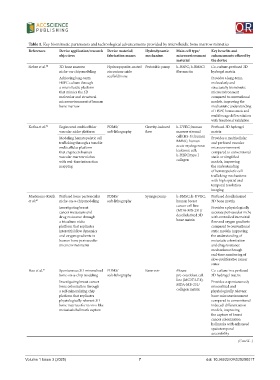
Table 1. Key biomimetic parameters and technological advancements provided by microfluidic bone marrow mimetics
             References   Device application/research  Device material/  Hydrodynamic   Main cell type/  Key benefits and
                          objectives           fabrication means  mechanism  microenvironment   enhancements offered by
                                                                            material       the device
             Sieber et al. 58  3D bone marrow   Hydroxyapatite-coated  Peristaltic pump  h-HSPC; h-BMSC/  Co-culture-perfused 3D
                          niche-on-chip modeling  zirconium oxide           fibronectin    hydrogel matrix
                          Achieving long-term   scaffold/none                              Provides a long-term,
                          HSPC culture through                                             molecularly and
                          a microfluidic platform                                          structurally biomimetic
                          that mimics the 3D                                               microenvironment
                          molecular and structural                                         compared to conventional
                          microenvironment of human                                        models, improving the
                          bone marrow                                                      mechanistic understanding
                                                                                           of HSPC homeostasis and
                                                                                           multilineage differentiation
                                                                                           with functional validation
             Kotha et al. 59  Engineered multicellular   PDMS/  Gravity-induced   h-UVEC; human   Perfused 3D hydrogel
                          vascular niche platform  soft-lithography  flow   marrow stromal   matrix
                          Modeling hematopoietic cell                       cell (HS-5); human   Provides a multicellular
                          trafficking through a tunable                     BMNC; human    and perfused vascular
                          multicellular platform                            acute myelogenous   microenvironment
                          that engineers human                              leukemic cell;   compared to conventional
                          vascular marrow niches                            h-HSPC/type I   static or simplified
                          with real-time interaction                        collagen       models, improving
                          mapping                                                          the understanding
                                                                                           of hematopoietic cell
                                                                                           trafficking mechanisms
                                                                                           with high spatial and
                                                                                           temporal resolution
                                                                                           imaging
             Marturano-Kruik  Perfused bone perivascular   PDMS/  Syringe pump  h-BMSC; h-UVEC;   Perfused decellularized
             et al. 60    niche-on-a-chip modeling  soft-lithography        human breast   3D bone matrix
                          Investigating breast                              cancer cell line   Provides a physiologically
                          cancer metastasis and                             (MDA-MB-231)/  accurate perivascular niche
                          drug resistance through                           decellularized 3D   with controlled interstitial
                          a triculture niche                                bone matrix    flow and oxygen gradients
                          platform that replicates                                         compared to conventional
                          interstitial flow dynamics                                       static models, improving
                          and oxygen gradients in                                          the understanding of
                          human bone perivascular                                          metastatic colonization
                          microenvironments                                                and drug resistance
                                                                                           mechanisms through
                                                                                           real-time monitoring of
                                                                                           slow-proliferative cancer
                                                                                           states
             Hao et al. 61  Spontaneous 3D-mineralized  PDMS/  Reservoir    Mouse          Co-culture in a perfused
                          bone-on-a-chip modeling  soft-lithography         pre-osteoblast cell   3D hydrogel matrix
                          Investigating breast cancer                       line (MC3T3-E1);   Provides a spontaneously
                          bone colonization through                         MDA-MB-231/    mineralized and
                          a self-mineralizing chip                          collagen matrix  physiologically relevant
                          platform that replicates                                         bone microenvironment
                          physiologically relevant 3D                                      compared to conventional
                          bone matrices for in vivo-like                                   induced-differentiation
                          metastasis hallmark capture                                      models, improving
                                                                                           the capture of breast
                                                                                           cancer colonization
                                                                                           hallmarks with enhanced
                                                                                           spatiotemporal
                                                                                           accessibility
                                                                                                      (Cont'd...)


            Volume 1 Issue 3 (2025)                         7                            doi: 10.36922/OR025200017

