


Page 61 - DP-1-1
P. 61
Design+                                                        Approximate signed multipliers design approach


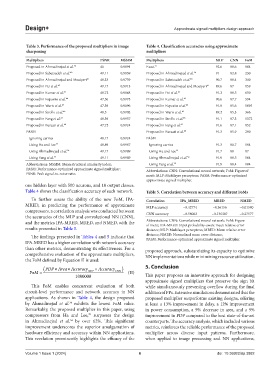
            Table 3. Performance of the proposed multipliers in image   Table 4. Classification accuracies using approximate
            sharpening                                         multipliers
            Multipliers                     PSNR    MSSIM      Multipliers                   MLP   CNN   FoM
            Proposed in Ahmadinejad et al. 34  46   0.9891     Exact 31                      92.6  88.6  804
            Proposed in Sabetzadeh et al. 40  49.11  0.9859    Proposed in Ahmadinejad et al. 34  91  82.8  230
            Proposed in Ahmadinejad and Moaiyeri 41  48.33  0.9739  Proposed in Sabetzadeh et al. 40  90.7  88.4  340
            Proposed in Pei et al. 42       49.17   0.9913     Proposed in Ahmadinejad and Moaiyeri 41  89.6  87  859
            Proposed in Kumar et al. 43     48.72   0.9848     Proposed in Pei et al. 42     91.2  88.5  650
            Proposed in Esposito et al. 44  47.56   0.9978     Proposed in Kumar et al. 43   90.6  87.7  594
            Proposed in Waris et al. 45     47.39   0.9696     Proposed in Esposito et al. 44  91.8  85.6  1095
            Proposed in Strollo et al. 46   48.5    0.9902     Proposed in Waris et al. 45   89.2  85.3  366
            Proposed in Fang et al. 47      48.39   0.9957     Proposed in Strollo et al. 46  91.1  87.3  1372
            Proposed in Baraati et al. 48   47.72   0.9924     Proposed in Fang et al. 47    91.6  87.1  852
            PASM                                               Proposed in Baraati et al. 48  91.3  85.9  290
             Ignoring carries               48.17   0.9924     PASM
             Using Ha and Lee 33            48.89   0.9967      Ignoring carries             91.3  86.7  194
             Using Ahmadinejad et al. 34    49.17   0.9989      Using Ha and Lee 33          91.7  88    87
             Using Yang et al. 35           49.11   0.9989      Using Ahmadinejad et al. 34  91.9  88.5  104
            Abbreviations: MSSIM: Mean structural similarity index;    Using Yang et al. 35  91.9  88.4  104
            PASM: Performance-optimized approximate signed multiplier;    Abbreviations: CNN: Convolutional neural network; FoM: Figure of
            PSNR: Peak signal-to-noise ratio.                  merit; MLP: Multilayer perceptron; PASM: Performance-optimized
                                                               approximate signed multiplier.
            one hidden layer with 500 neurons, and 10 output classes.
            Table 4 shows the classification accuracy of each network.  Table 5. Correlation between accuracy and different FoMs
              To further assess  the ability  of  the new FoM, IPA-  Correlation  IPA_MRED  MRED       NMED
            MRED, in predicting the performance of approximate   MLP accuracy  −0.42774     −0.36156   −0.01540
            compressors, a correlation analysis was conducted between   CNN accuracy  −0.58002  −0.136387  −0.27577
            the accuracies of the MLP and convolutional NN (CNN),
            and the metrics IPA-MRED, MRED, and NMED, with the   Abbreviations: CNN: Convolutional neural network; FoM: Figure
                                                               of merit; IPA-MRED: Input probability-aware mean relative error
            results presented in Table 5.                      distance; MLP: Multilayer perceptron; MRED: Mean relative error
              The findings presented in Tables 4 and 5 indicate that   distance; NMED: Normalized mean error distance;
                                                               PASM: Performance-optimized approximate signed multiplier.
            IPA-MRED has a higher correlation with network accuracy
            than other metrics, demonstrating its effectiveness. For a   proposed approach, substantiating its capacity to optimize
            comprehensive evaluation of the approximate multipliers,   NN implementations while minimizing resource utilization.
            the FoM defined by Equation II is used:

                              ×
                   (PDP Area Accuracy    ×  Accuracy  )        5. Conclusion
                        ×
              FoM =                    MLP        CNN  (II)
                                 1000000                       This paper proposes an innovative approach for designing
                                                               approximate signed multipliers that preserve the sign bit
              This FoM enables concurrent evaluation of both   while simultaneously preventing overflow during the final
            circuit-level performance and network accuracy in NN   addition of PPs. Extensive simulations demonstrated that the
            applications. As shown in  Table 4, the design proposed   proposed multiplier outperforms existing designs, offering
            by Ahmadinejad  et  al.  exhibits the lowest FoM value.   at least a 13% improvement in delay, a 12% improvement
                               34
            Remarkably, the proposed multiplier in this paper, using   in power consumption, a 9% decrease in area, and a 9%
            compressors from Ha and Lee,  surpasses the design   improvement in PDP compared to the best state-of-the-art
                                       33
            in Ahmadinejad  et al.  by over 62%. This significant   counterparts. The accuracy analysis, which included various
                               34
            improvement underscores the superior amalgamation of   metrics, reinforces the reliable performance of the proposed
            hardware efficiency and accuracy within NN applications.   multiplier across diverse input patterns. Furthermore,
            This revelation prominently highlights the efficacy of the   when applied to image processing and NN applications,


            Volume 1 Issue 1 (2024)                         6                                doi: 10.36922/dp.3882

