


Page 286 - EJMO-9-2
P. 286
Eurasian Journal of
            Medicine and Oncology                                          QGJSF multi-target mechanisms in osteoporosis


              ROC curve analysis was then performed to explore the   through ERRα-mediated mitochondrial biogenesis and
            diagnostic effects of the seven hub genes. In the GSE35958   regulates MAPK, NF-κB, and NRF2/HO-1 pathways. 12,13
            dataset, the area under the curve (AUC) values were as   Calycosin  inhibits  RANKL-induced  osteoclastogenesis,
            follows:  TGFB1,  AKT1,  CTNNB1,  and  TP53  all  had  an   upregulates OPG, and activates PI3K/AKT and Wnt/β-
            AUC of 1.000, MMP2 was 0.500, BCL2L1 was 0.950, and   catenin pathways to support osteoblast function and bone
            MAPK3 was 0.750. Except for MMP2, all other genes had   mineralization, while its antioxidant properties improve
            AUC values >0.7, suggesting good diagnostic performance   bone microstructure. 14-16  Berberine reduces oxidative
            (Figure 8H).                                       damage, suppresses RANKL/OPG signaling to inhibit
                                                               osteoclasts, and promotes osteoblastogenesis through
            3.10. GSEA analysis                                PKA, p38 MAPK, Wnt/β-catenin, and AMPK pathways,
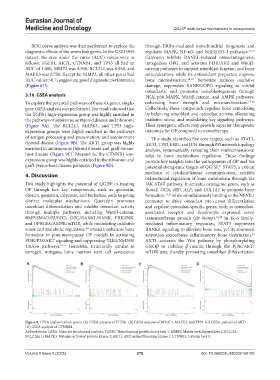
            To explore the potential pathways of these six genes, single-  enhancing bone strength and microarchitecture. 17-20
            gene GSEA analysis was performed. The results showed that   Collectively, these compounds regulate bone remodeling
            the TGFB1 high-expression group was highly enriched in   by balancing osteoblast and osteoclast activity, alleviating
            the pathways of autoimmune thyroid disease and ribosome   oxidative stress, and modulating key signaling pathways.
            (Figure  9A). The BCL2L1, MAPK3, and TP53 high-    Their synergistic effects may provide superior therapeutic
            expression groups were highly enriched in the pathways   outcomes for OP compared to monotherapy.
            of antigen processing and presentation, and autoimmune   This study identified five core targets, such as STAT3,
            thyroid disease (Figure 9B). The AKT1 group was highly   AKT1, TP53, ESR1, and JUN, through PPI network topology
            enriched in autoimmune thyroid disease and graft-versus-  analysis, systematically revealing their multidimensional
            host disease (Figure 9C). Meanwhile, the CTNNB1 low-  roles in bone metabolism regulation. These findings
            expression group was highly enriched in the ribosome and   provide key insights into the pathogenesis of OP and the
            graft-versus-host disease pathways (Figure 9D).    potential therapeutic targets of QGJSF.  STAT3, a critical
                                                                                              21
            4. Discussion                                      mediator of cytokine-kinase communication, exhibits
                                                               bidirectional regulation of bone metabolism through the
            This study highlights the potential of QGJSF in treating   JAK-STAT pathway. It activates osteogenic genes, such as
            OP through five key components, such as quercetin,   Runx2,  OCN,  BSP,  ALP,  and  COL1A1  to  promote  bone
            dioscin, genistein, calycosin, and berberine, each targeting   formation, 21,22  while simultaneously binding to the NFATc1
            distinct molecular mechanisms. Quercetin promotes   promoter to drive osteoclast pre-cursor differentiation
            osteoblast differentiation and inhibits osteoclast activity   and regulate osteoclast-specific genes, such as osteoclast-
            through multiple pathways, including Wnt/β-catenin,   associated receptor and dendrocyte expressed seven
            BMP/SMAD/RUNX2, OPG/RANKL/RANK, ERK/JNK,           transmembrane protein (Dc-Stamp). 23,24  In IL-6 family-
            and GPRC6A/AMPK/mTOR, while modulating oxidative   mediated inflammatory responses, STAT3 suppresses
            stress and metabolic regulation.  Dioscin enhances bone   RANKL signaling to alleviate bone loss, yet its abnormal
                                     8,9
                                                                                                            25
            formation in post-menopausal OP models by activating   activation exacerbates inflammatory bone destruction.
            PI3K/P38/AKT signaling and suppressing TLR4/MyD88/  AKT1  activates  the  Wnt  pathway  by phosphorylating
            TRAF6 pathways. 10,11  Genistein, structurally similar to   GSK3β to stabilize  β-catenin through the PI3K/AKT/
            estrogen, mitigates bone marrow stem cell senescence   mTOR axis, thereby promoting osteoblast differentiation

            A                      B                        C                        D


            Figure 9. GSEA analysis of hub genes. (A) GSEA analysis of TGFB1. (B) GSEA analysis of BCL2L1, MAPK3, and TP53. (C) GSEA analysis of AKT1.
            (D) GSEA analysis of CTNNB1.
            Abbreviations: GSEA: Gene set enrichment analysis; TGFB1: Transforming growth factor beta 1; MMP2: Matrix metallopeptidase 2; BCL2L1:
            BCL2 like 1; MAPK3: Mitogen-activated protein kinase 3; AKT1: AKT serine/threonine kinase 1: CTNNB1: Catenin beta 1.


            Volume 9 Issue 2 (2025)                        278                         doi: 10.36922/EJMO025150103

