


Page 66 - ESAM-1-4
P. 66
Engineering Science in
            Additive Manufacturing                                             EST manipulates structure of Ti-6Al-4V/Cu


                        A                        B                       C


                         D                       E                       F


                        G                        H                       I


                         J                       K                       L


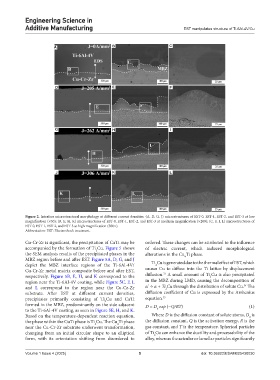
            Figure 2. Interface microstructural morphology at different current densities. (A, D, G, J) microstructures of EST-0, EST-1, EST-2, and EST-3 at low
            magnification (×50); (B, E, H, K) microstructures of EST-0, EST-1, EST-2, and EST-3 at medium magnification (×200); (C, F, I, L) microstructures of
            EST-0, EST-1, EST-2, and EST-3 at high magnification (500×).
            Abbreviation: EST: Electroshock treatment.

            Cu-Cr-Zr is significant, the precipitation of CuTi may be   ordered. These changes can be attributed to the influence
            accompanied by the formation of Ti Cu. Figure 5 shows   of  electric  current,  which  induced  morphological
                                          2
            the SEM analysis results of the precipitated phases in the   alterations in the Cu Ti phase.
                                                                                4
            MBZ region before and after EST. Figure 5A, D, G, and J   Ti Cu is generated due to the thermal effect of EST, which
            depict the MBZ interface regions of the Ti-6Al-4V/     2
            Cu-Cr-Zr metal matrix composite before and after EST,   causes  Cu  to  diffuse  into  the  Ti  lattice  by  displacement
                                                                      33
            respectively.  Figure  5B,  E,  H, and  K correspond to the   diffusion.  A small amount of Ti Cu is also precipitated
                                                                                          2
            region near the Ti-6Al-4V coating, while Figure 5C, F, I,   in the MBZ during LMD, causing the decomposition of
                                                                                                         34
            and  L  correspond to  the  region near  the  Cu-Cr-Zr   α’ → α + Ti Cu through the distribution of solute Cu.  The
                                                                       2
            substrate. After EST at different current densities,   diffusion coefficient of Cu is expressed by the Arrhenius
            precipitates primarily consisting of Ti Cu and CuTi   equation. 35
                                              2
            formed in the MBZ, predominantly on the side adjacent   D = D  exp (−Q/RT)                     (1)
            to the Ti-6Al-4V coating, as seen in Figure 5E, H, and K.   0
            Based on the temperature-dependent reaction equation,   Where D is the diffusion constant of solute atoms, D  is
                                                                                                           0
            the phase within the CuTi phase is Ti Cu. The Cu Ti phase   the diffusion constant, Q is the activation energy, R is the
                                         2
                                                   4
            near the Cu-Cr-Zr substrate underwent transformation,   gas constant, and T is the temperature. Spherical particles
            changing from an initial circular shape to an elliptical   of Ti Cu can enhance the ductility and processability of the
                                                                   2
            form, with its orientation shifting from disordered to   alloy, whereas the acicular or lamellar particles significantly
            Volume 1 Issue 4 (2025)                         5                          doi: 10.36922/ESAM025430030

