


Page 68 - ESAM-1-4
P. 68
Engineering Science in
            Additive Manufacturing                                             EST manipulates structure of Ti-6Al-4V/Cu


                         A                                   B


                         C                                     D


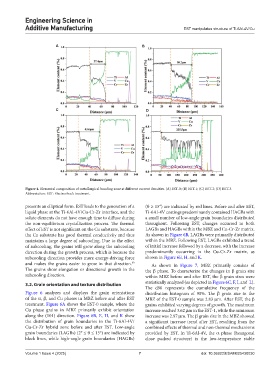
            Figure 4. Elemental composition of metallurgical bonding zone at different current densities. (A) EST-0; (B) EST-1; (C) EST-2; (D) EST-3.
            Abbreviation: EST: Electroshock treatment.

            presents an elliptical form. EST leads to the generation of a   (θ ≥ 15°) are indicated by red lines. Before and after EST,
            liquid phase at the Ti-6Al-4V/Cu-Cr-Zr interface, and the   Ti-6Al-4V coatings predominantly contained HAGBs with
            solute elements do not have enough time to diffuse during   a small number of low-angle grain boundaries distributed
            the non-equilibrium crystallization process. The thermal   throughout.  Following  EST,  changes occurred in  both
            effect of EST is not significant on the Cu substrate, because   LAGBs and HAGBs within the MBZ and Cu-Cr-Zr matrix.
            the Cu substrate has good thermal conductivity and thus   As shown in Figure 6B, LAGBs were primarily distributed
            maintains a large degree of subcooling. Due to the effect   within the MBZ. Following EST, LAGBs exhibited a trend
            of subcooling, the grains will grow along the subcooling   of initial increase followed by a decrease, with the increase
            direction during the growth process, which is because the   predominantly occurring in the Cu-Cr-Zr matrix, as
            subcooling direction provides more energy-driving force   shown in Figure 6E, H, and K.
            and makes the grains easier  to grow in that direction.    As shown in  Figure  7, MBZ primarily consists of
                                                         39
            The grains show elongation or directional growth in the   the β phase. To characterize the changes in β grain size
            subcooling direction.                              within MBZ before and after EST, the β grain sizes were

            3.2. Grain orientation and texture distribution    statistically analyzed (as depicted in Figure 6C, F, I, and  L).
                                                               The  d90  represents  the  cumulative  frequency  of  the
            Figure  6  analyzes  and  displays  the  grain  orientations   distribution histogram of 90%. The  β grain size  in the
            of the α, β, and Cu phases in MBZ before and after EST   MBZ of the EST-0 sample was 2.83 μm. After EST, the β
            treatment. Figure 6A shows the EST-0 sample, where the   grains exhibited varying degrees of growth. The maximum
            Cu phase grains in MBZ primarily exhibit orientation   increase reached 3.62 μm in the EST-1, while the minimum
            along the (101) direction.  Figure  6B,  E,  H, and  K show   increase was 2.97 μm. The β grain size in the MBZ showed
            the distribution of grain boundaries in the Ti-6Al-4V/  a significant increase trend after EST, resulting from the
            Cu-Cr-Zr hybrid zone before and after EST. Low-angle   combined effects of thermal and non-thermal mechanisms
            grain boundaries (LAGBs) (2° ≤ θ ≤ 15°) are indicated by   provided by EST. In Ti-6Al-4V, the  α phase (hexagonal
            black lines, while high-angle grain boundaries (HAGBs)   close packed structure) is the low-temperature stable


            Volume 1 Issue 4 (2025)                         7                          doi: 10.36922/ESAM025430030

