


Page 72 - ESAM-1-4
P. 72
Engineering Science in
            Additive Manufacturing                                             EST manipulates structure of Ti-6Al-4V/Cu


                         A                                  E


                         B                                  F


                         C                                  G


                         D                                   H


            Figure 8. Texture distributions of α and β phases. (A) α phase EST-0; (B) α phase EST-1; (C) α phase EST-2; (D) α phase EST-3, (E) β phase EST-0; (F) β
            phase EST-1; (G) β phase EST-2; (H) β phase EST-3.
            Abbreviation: EST: Electroshock treatment.

                         A                      B                       C


                                                                  E
                                D


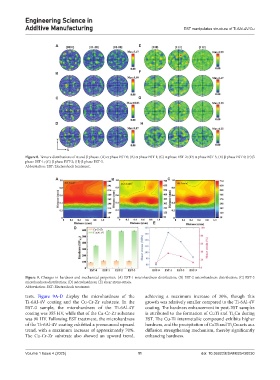
            Figure 9. Changes in hardness and mechanical properties. (A) EST-1 microhardness distribution; (B) EST-2 microhardness distribution; (C) EST-3
            microhardness distribution; (D) microhardness; (E) shear stress-strain.
            Abbreviation: EST: Electroshock treatment.
            tests.  Figure  9A-D display the microhardness of the   achieving a maximum increase of 30%, though this
            Ti-6Al-4V coating and the Cu-Cr-Zr substrate. In the   growth was relatively smaller compared to the Ti-6Al-4V
            EST-0  sample, the microhardness of the Ti-6Al-4V   coating. The hardness enhancement in post-EST samples
            coating was 355 HV, while that of the Cu-Cr-Zr substrate   is attributed to the formation of CuTi and Ti Cu during
                                                                                                    2
            was 90 HV. Following EST treatment, the microhardness   EST. The Cu-Ti intermetallic compound exhibits higher
            of the Ti-6Al-4V coating exhibited a pronounced upward   hardness, and the precipitation of CuTi and Ti Cu acts as a
                                                                                                    2
            trend, with a maximum increase of approximately 70%.   diffusion strengthening mechanism, thereby significantly
            The Cu-Cr-Zr substrate also showed an upward trend,   enhancing hardness.


            Volume 1 Issue 4 (2025)                         11                         doi: 10.36922/ESAM025430030

