


Page 71 - ESAM-1-4
P. 71
Engineering Science in
            Additive Manufacturing                                             EST manipulates structure of Ti-6Al-4V/Cu


                                                                        C
                         A                      B


                                                                        F
                         D                       E


                                                                        I
                         G                      H


                         J                      K                       L


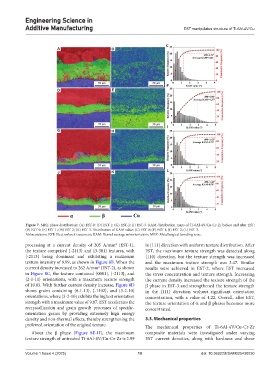
            Figure 7. MBZ phase distribution: (A) EST-0; (D) EST-1; (G) EST-2; (J) EST-3. KAM distribution maps of Ti-6Al-4V/Cu-Cr-Zr before and after EST:
            (B) EST-0; (E) EST-1; (H) EST-2; (K) EST-3. Distribution of KAM value: (C) EST-0; (F) EST-1; (I) EST-2; (L) EST-3.
            Abbreviations: EST: Electroshock treatment; KAM: Kernel average misorientation; MBZ: Metallurgical bonding zone.
            processing at a current density of 205  A/mm  (EST-1),   in {111} direction with uniform texture distribution. After
                                                  2
            the texture comprised {-2113} and {3-301} textures, with   EST, the maximum texture strength was detected along
            {-2113} being dominant and exhibiting a maximum    {110} direction, but the texture strength was increased
            texture intensity of 9.99, as shown in Figure 8B. When the   and the maximum texture strength was 3.47. Similar
                                           2
            current density increased to 262 A/mm  (EST-2), as shown   results were achieved in EST-2, where EST increased
            in  Figure  8C, the texture contained {0001}, {-2113}, and   the stress concentration and texture strength. Increasing
            {2-1-11}  orientations, with  a maximum  texture strength   the current density increased the texture strength of the
            of 10.03. With further current density increase, Figure 8D   β phase in EST-3 and strengthened the texture strength
            shows grains containing {0-1-13}, {-1102}, and {3-2-10}   in the {111} direction without significant orientation
            orientations, where {3-2-10} exhibits the highest orientation   concentration, with a value of 4.22. Overall, after EST,
            strength with a maximum value of 9.87. EST accelerates the   the texture orientation of α and β phases becomes more
            recrystallization and grain growth processes of specific-  concentrated.
            orientation grains by providing extremely high energy
            density and non-thermal effects, thereby strengthening the   3.3. Mechanical properties
            preferred orientation of the original texture.     The mechanical properties of Ti-6Al-4V/Cu-Cr-Zr
              About the  β phase (Figure  8E-H), the maximum   composite materials were investigated under varying
            texture strength of untreated Ti-6Al-4V/Cu-Cr-Zr is 2.99   EST current densities, along with hardness and shear


            Volume 1 Issue 4 (2025)                         10                         doi: 10.36922/ESAM025430030

