


Page 69 - ESAM-1-4
P. 69
Engineering Science in
            Additive Manufacturing                                             EST manipulates structure of Ti-6Al-4V/Cu


                         A                       B                       C


                         D                       E                       F


                        G                        H                       I


                         J                       K                       L


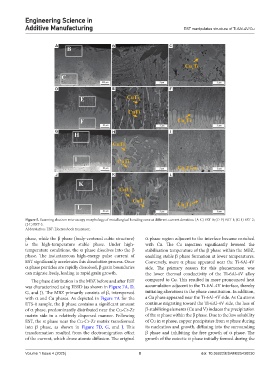
            Figure 5. Scanning electron microscopy morphology of metallurgical bonding zone at different current densities. (A-C) EST-0; (D-F) EST-1; (G-I) EST-2;
            (J-L) EST-3.
            Abbreviation: EST: Electroshock treatment.
            phase, while the β phase (body-centered cubic structure)   α phase region adjacent to the interface became enriched
            is the high-temperature stable phase. Under high-  with Cu. The Cu injection significantly lowered the
            temperature conditions, the α phase dissolves into the β   stabilization temperature of the β phase within the MBZ,
            phase.  The instantaneous high-energy pulse  current of   enabling stable β phase formation at lower temperatures.
            EST significantly accelerates this dissolution process. Once   Conversely, more  α phase appeared near the Ti-6Al-4V
            α phase particles are rapidly dissolved, β grain boundaries   side. The primary reason for this phenomenon was
            can migrate freely, leading to rapid grain growth.  the lower thermal conductivity of the Ti-6Al-4V alloy
              The phase distribution in the MBZ before and after EST   compared to Cu. This resulted in more pronounced heat
            was characterized using EBSD (as shown in Figure 7A, D,   accumulation adjacent to the Ti-6Al-4V interface, thereby
            G, and J). The MBZ primarily consists of β, interspersed   initiating alterations in the phase constitution. In addition,
            with α and Cu phases. As depicted in Figure 7A for the   a Cu phase appeared near the Ti-6Al-4V side. As Cu atoms
            ETS-0 sample, the β phase contains a significant amount   continue migrating toward the Ti-6Al-4V side, the loss of
            of α phase, predominantly distributed near the Cu-Cr-Zr   β-stabilizing elements (Cu and V) induces the precipitation
            matrix side in a relatively dispersed manner. Following   of the α phase within the β phase. Due to the low solubility
            EST, the α phase near the Cu-Cr-Zr matrix transformed   of Cu in α phase, copper precipitates from α phase during
            into  β phase, as shown in  Figure  7D,  G, and  J. This   its nucleation and growth, diffusing into the surrounding
            transformation resulted from the electromigration effect   β phase and inhibiting the free growth of  α phase. The
            of the current, which drove atomic diffusion. The original   growth of the eutectic α phase initially formed during the


            Volume 1 Issue 4 (2025)                         8                          doi: 10.36922/ESAM025430030

