


Page 70 - ESAM-1-4
P. 70
Engineering Science in
            Additive Manufacturing                                             EST manipulates structure of Ti-6Al-4V/Cu


                         A                      B                       C


                                                                         F
                         D                       E


                         G                      H                       I


                         J                      K                       L


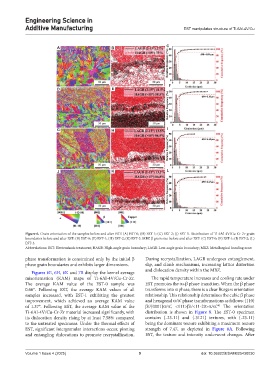
            Figure 6. Grain orientation of the samples before and after EST: (A) EST-0; (D) EST-1; (G) EST-2; (J) EST-3. Distribution of Ti-6Al-4V/Cu-Cr-Zr grain
            boundaries before and after EST: (B) EST-0; (E) EST-1; (H) EST-2; (K) EST-3. MBZ β grain size before and after EST: (C) EST-0; (F) EST-1; (I) EST-2; (L)
            EST-3.
            Abbreviations: EST: Electroshock treatment; HAGB: High-angle grain boundary; LAGB: Low-angle grain boundary; MBZ: Metallurgical bonding zone.

            phase transformation is constrained only by the initial β   During recrystallization, LAGB undergoes entanglement,
            phase grain boundaries and exhibits larger dimensions.  slip, and climb mechanisms, increasing lattice distortion
                                                               and dislocation density within the MBZ.
              Figures 6E, 6H, 6K and 7B display the kernel average
            misorientation (KAM)  maps of  Ti-6Al-4V/Cu-Cr-Zr.   The rapid temperature increases and cooling rate under
            The average KAM value of the EST-0  sample was     EST promotes the α+β phase transition. When the β phase
            0.66°. Following EST, the average KAM values of all   transforms into α phase, there is a clear Burgers orientation
            samples increased, with EST-1 exhibiting the greatest   relationship. This relationship determines the cubic β phase
            improvement, which achieved an average KAM value   and hexagonal α/α’ phase transformations as follows: {110}
                                                                                             40
            of 1.37°. Following EST, the average KAM value of the   β//{0001}α/α’,  <111>β//<11-20>α/α’.   The  orientation
            Ti-6Al-4V/Cu-Cr-Zr material increased significantly, with   distribution is shown in  Figure  8. The EST-0  specimen
            its dislocation density rising by at least 7.58% compared   contains {-23-11} and {-3121} textures, with {-23-11}
            to the untreated specimens. Under the thermal effects of   being the dominant texture exhibiting a maximum texture
            EST, significant intergranular interactions occur, pinning   strength of 7.47, as depicted in  Figure  8A. Following
            and entangling dislocations to promote recrystallization.   EST, the texture and intensity underwent changes. After


            Volume 1 Issue 4 (2025)                         9                          doi: 10.36922/ESAM025430030

