


Page 12 - GPD-2-2
P. 12
Gene & Protein in Disease                                                              MOR in cancer


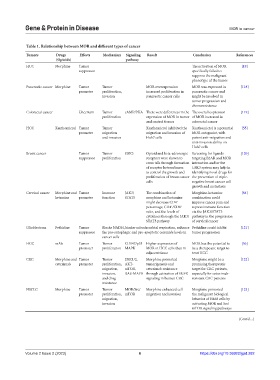
            Table 1. Relationship between MOR and different types of cancer
            Tumors       Drugs     Effects   Mechanism  Signaling   Result         Conclusion         References
                         (Opioids)                     pathway
            HCC          Morphine  Tumor                                           The activation of MOR   [19]
                                   suppressor                                      specifically failed to
                                                                                   suppress the malignant
                                                                                   phenotype of the tumor
            Pancreatic cancer Morphine  Tumor   Tumor          MOR overexpression   MOR was expressed in   [118]
                                   promoter  proliferation,    increased proliferation in   pancreatic cancer and
                                            invasion           pancreatic cancer cells  might be involved in
                                                                                   tumor progression and
                                                                                   chemoresistance
            Colorectal cancer      Uncertain  Tumor   cAMP/PKA There were differences in the  The overall expression   [119]
                                            proliferation      expression of MOR in tumor  of MOR increased in
                                                               and control tissues  colorectal cancer
            HCC          Xanthomicrol Tumor   Tumor            Xanthomicrol inhibited the   Xanthomicrol is a potential   [55]
                                   promoter  migration         migration and invasion of   MOR antagonist, with
                                            and invasion       Huh7 cells          potent anti-migration and
                                                                                   anti-invasion ability on
                                                                                   Huh7 cells
            Breast cancer          Tumor    Tumor     GSK3     Opioid and beta-adrenergic  Screening for ligands   [120]
                                   suppressor  proliferation   receptors were shown to   targeting B2AR and MOR
                                                               cross talk through formation  interaction and/or the
                                                               of receptor heterodimers   GSK3 system may help in
                                                               to control the growth and   identifying novel drugs for
                                                               proliferation of breast cancer  the prevention of triple-
                                                               cells               negative breast cancer cell
                                                                                   growth and metastasis
            Cervical cancer  Morphine and  Tumor   Immune   JAK3/  The combination of   Morphine-ketamine   [84]
                         ketamine  promoter  function  STAT5   morphine and ketamine   combination could
                                                               might decrease CD4   +  improve cancer pain and
                                                               percentage, CD4 /CD8    repress immune function
                                                                          +
                                                                              +
                                                               ratio, and the levels of   via the JAK3/STAT5
                                                               cytokines through the JAK3/ pathway in the progression
                                                               STAT5 pathway       of cervical cancer
            Glioblastoma  Pethidine  Tumor   Blocks NADH, hinder mitochondrial respiration, enhance  Pethidine could inhibit   [121]
                                   suppressor  the pro-autophagic and pro-apoptotic ceramide levels in   tumor progression
                                            cancer cells
            HCC          mAb       Tumor    Tumor     CD147/p53  Higher expression of   MOR has the potential to   [56]
                                   promoter  proliferation  MAPK  MOR in HCC cells than in   be a therapeutic target to
                                                               adjacent tissue     treat HCC
            CRC          Morphine and  Tumor   Tumor   ERK1/2,   Morphine promoted   Morphine might be a   [122]
                         cetuximab  promoter  proliferation,  AKT-  tumorigenesis and   promising therapeutic
                                            migration,   mTOR,   cetuximab resistance   target for CRC patients,
                                            invasion,   RAS-MAPK through activation of EGFR  especially for cetuximab-
                                            and drug           signaling in human CRC  resistant CRC patients
                                            resistance
            NSCLC        Morphine  Tumor    Tumor     MOR/Src/  Morphine enhanced cell   Morphine promoted   [123]
                                   promoter  proliferation,  mTOR  migration and invasion  the malignant biological
                                            migration,                             behavior of H460 cells by
                                            invasion                               activating MOR and Src/
                                                                                   mTOR signaling pathways

                                                                                                       (Cont’d....)


            Volume 2 Issue 2 (2023)                         6                         https://doi.org/10.36922/gpd.282

