


Page 13 - GPD-2-2
P. 13
Gene & Protein in Disease                                                              MOR in cancer


            Table 1. (Continued)
            Tumors       Drugs     Effects   Mechanism  Signaling   Result         Conclusion         References
                         (Opioids)                     pathway
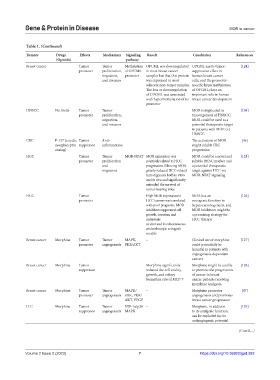
            Breast cancer          Tumor    Tumor     Methylation  OPCML was downregulated  OPCML exerts tumor-  [124]
                                   promoter  proliferation,  of OPCML   in most breast cancer   suppressive effect in
                                            migration,   promoter  samples but that this protein  human breast cancer
                                            and invasion       was expressed in most   cells, and the promoter-
                                                               adjacent non-tumor samples.  specific hypermethylation
                                                               The loss or downregulation   of OPCML plays an
                                                               of OPCML was associated   important role in human
                                                               with hypermethylation of its  breast cancer development
                                                               promoter
            HNSCC        No limits  Tumor   Tumor                                  MOR is implicated in   [108]
                                   promoter  proliferation,                        tumorigenesis of HNSCC.
                                            migration,                             MOR could be used as a
                                            and invasion                           potential therapeutic target
                                                                                   in patients with MOR (+)
                                                                                   HNSCC
            CRC          P-137 (a cyclic  Tumor   Anti-                            The activation of MOR   [46]
                         morphiceptin  suppressor  inflammation                    might inhibit CRC
                         analog)                                                   progression
            HCC                    Tumor    Tumor     MOR-NFAT MOR expression was   MOR could be a novel and   [125]
                                   promoter  proliferation     positively related to HCC   reliable HCSC marker and
                                            and                progression. Silencing MOR   a potential therapeutic
                                            migration          greatly reduced HCC-related   target against HCC via
                                                               tumorigenesis both in vitro   MOR-NFAT signaling
                                                               and in vivo and significantly
                                                               extended the survival of
                                                               tumor-bearing mice
            HCC                    Tumor                       High MOR expression in   MOR has an     [126]
                                   promoter                    HCC tumors was correlated   oncogenic function in
                                                               with poor prognosis. MOR   hepatocarcinogenesis, and
                                                               inhibitors suppressed cell   MOR inhibitors might be
                                                               growth, invasion, and   a promising strategy for
                                                               metastasis          HCC therapy
                                                               in vitro and in subcutaneous
                                                               and orthotopic xenograft
                                                               models
            Breast cancer  Morphine  Tumor   Tumor    MAPK,    –                   Clinical use of morphine   [127]
                                   promoter  angiogenesis PKB/AKT                  could potentially be
                                                                                   harmful in patients with
                                                                                   angiogenesis-dependent
                                                                                   cancers
            Breast cancer  Morphine  Tumor                     Morphine significantly   Morphine might be unable   [128]
                                   suppressor                  reduced the cell vitality,   to promote the progression
                                                               growth, and colony   of cancer in breast
                                                               formation rate of MCF-7  cancer patients receiving
                                                                                   morphine analgesia
            Breast cancer  Morphine  Tumor   Tumor    MAPK/    –                   Morphine promotes    [47]
                                   promoter  angiogenesis ERK, PI3k/               angiogenesis and promotes
                                                      AKT, VEGF                    breast cancer progression
            LLC          Morphine  Tumor    Tumor     HIF-1α/p38  –                Morphine, in addition   [129]
                                   suppressor  angiogenesis MAPK                   to its analgesic function,
                                                                                   can be exploited for its
                                                                                   antiangiogenic potential

                                                                                                       (Cont’d....)


            Volume 2 Issue 2 (2023)                         7                         https://doi.org/10.36922/gpd.282

