


Page 77 - GTM-4-3
P. 77
Global Translational Medicine                                     Precision medicine via personalized nutrition


            metabolic state, nutrient deficiencies, disease risk, and   These areas primarily focus on understanding how
            optimal dietary needs. As technology continues to advance,   dietary compounds and their metabolites affect the
            proteomics analysis will become increasingly feasible and   host over time after consumption. They also aim to find
            affordable, paving the way for PN to become a standard   biomarkers related to diet and determine how the dose of
            approach to health care. Proteins and metabolites linked to   phytochemicals influences the connection between diet
            dietary patterns may serve as prognostic markers, guiding   and health. Furthermore, metabolites serve as crucial
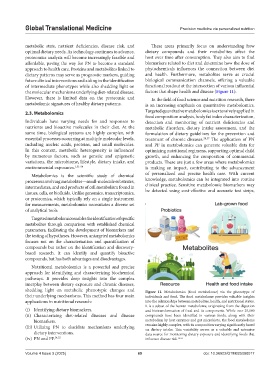
            future clinical interventions and aiding in the identification   biological communication channels, offering a valuable
            of intermediate phenotypes while also shedding light on   functional readout at the intersection of various influential
            the molecular mechanisms underlying diet-related disease.   factors that shape health and disease (Figure 11).
            However, there is limited data on the proteomic and   In the field of food science and nutrition research, there
            metabolomic signatures of healthy dietary patterns.  is an increasing emphasis on quantitative metabolomics.
            2.3. Metabolomics                                  Targeted quantitative metabolomics is extensively applied in
                                                               food composition analysis, body fat index characterization,
            Individuals  have  varying  needs  for  and  responses  to   detection and monitoring of nutrient deficiencies and
            nutrients and bioactive molecules in their diet. At the   metabolic disorders, dietary intake assessment, and the
            same time, biological systems are highly complex, with   formulation of dietary guidelines for the prevention and
            essential processes occurring at multiple molecular levels,   treatment of chronic diseases. 28,57  The application of PN
            including nucleic acids, proteins, and small molecules.   and PF in metabolomics can generate valuable data for
            In this context, metabolic heterogeneity is influenced   optimizing nutritional regimens, supporting optimal child
            by numerous factors, such as genetic and epigenetic   growth, and enhancing the composition of commercial
            variations, the microbiome, lifestyle, dietary intake, and   products. These are just a few areas where metabolomics
            environmental exposures. 3,51-54                   is making an impact, contributing to the advancement
              Metabolomics is the scientific study of chemical   of personalized and precise health care.  With current
            processes involving metabolites—small-molecule substrates,   knowledge, metabolomics can be integrated into routine
            intermediates, and end products of cell metabolism found in   clinical practice. Sensitive metabolomic biomarkers may
            tissues, cells, or biofluids. Unlike genomics, transcriptomics,   be detected using cost-effective and accurate test strips,
            or proteomics, which typically rely on a single instrument
            for measurements, metabolomics necessitates a diverse set
            of analytical tools.
              Targeted metabolomics enables the identification of specific
            metabolites through comparison with established chemical
            parameters, facilitating the development of biomarkers and
            the testing of hypotheses. However, untargeted metabolomics
            focuses not on the characterization and quantification of
            compounds but rather on the identification and discovery-
            based research. It can identify and quantify bioactive
            compounds, but has both advantages and disadvantages.
              Nutritional metabolomics is a powerful and precise
            approach for identifying and characterizing biochemical
            pathways. It provides deep  insights into the complex
            interplay between dietary exposure and chronic diseases,
            shedding light on metabolic phenotypic changes and   Figure  11.  Metabolomics (food metabolome) via the phenotype of
            their underlying mechanisms. This method has four main   individuals and food. The food metabolome provides valuable insights
            applications in nutritional research:              into the relationships between metabolites, health, and nutritional status.
                                                               It is a subset of the human metabolome, originating from the digestion
            (i)  Identifying dietary biomarkers.               and biotransformation of food and its components. While over 25,000
            (ii)  Characterizing diet-related diseases and disease   compounds have been identified in various foods, along with their
               biomarkers.                                     metabolism by host enzymes and gut microbiota, the food metabolome
            (iii) Utilizing PN to elucidate mechanisms underlying   remains highly complex, with its composition varying significantly based
                                                               on  dietary  intake.  This  variability  serves  as  a  valuable  and  extensive
               dietary interventions.                          data source for monitoring dietary exposure and identifying foods that
            (iv)  PN and PF. 54,55                             influence disease risk. 54,56


            Volume 4 Issue 3 (2025)                         69                          doi: 10.36922/GTM025080017

