


Page 58 - IJAMD-1-3
P. 58
International Journal of AI for
            Materials and Design
                                                            Phase change materials and digital twin technology in thermal energy


            fluctuating temperatures and changing energy demands,
            allowing for proactive adjustments that enhance energy
            efficiency. Furthermore, DT improves control strategies
            for heating and cooling applications, particularly within
            building energy management systems. By integrating real-
            time data, DT systems enable predictive maintenance,
            identify system inefficiencies, and improve overall
            operational reliability.
            1.2. Contributions

            The main contributions of this article are outlined below:
            •   A total of 89 research articles, including case studies,
               review papers, experimental analyses, and letters,
               were reviewed in the current study, sourced from
               databases such as Science Direct, IEEE, MDPI, Wiley,
               and Springer, among others.
            •   The present study describes TES as a versatile form
               of renewable energy, utilizing materials that absorb
               heat when heated and release it when cooled through
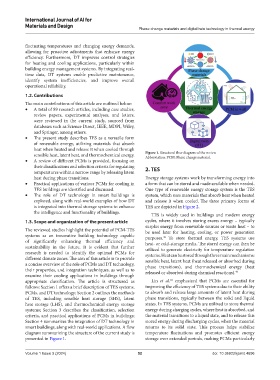
               sensible heat, latent heat, and thermochemical energy.  Figure 1. Structural flow diagram of the review
                                                               Abbreviation: PCM: Phase change material.
            •   A review of different PCMs is provided, focusing on
               their classifications and selection criteria for regulating   2. TES
               temperatures within a narrow range by releasing latent
               heat during phase transitions.                  Energy storage systems work by transforming energy into
            •   Practical applications of various PCMs for cooling in   a form that can be stored and made available when needed.
               TES buildings are identified and discussed.     One type of renewable energy storage system is the TES
            •   The role of DT technology in smart buildings is   system, which uses materials that absorb heat when heated
               explored, along with real-world examples of how DT   and release it when cooled. The three primary forms of
               is integrated into thermal storage systems to enhance   TES are depicted in Figure 2.
               the intelligence and functionality of buildings.
                                                                 TES is widely used in buildings and modern energy
            1.3. Scope and organization of the present article  cycles, where it involves storing excess energy – typically
                                                               surplus energy from renewable sources or waste heat – to
            The reviewed studies highlight the potential of PCM-TES   be used later for heating, cooling, or power generation
            systems as an innovative building technology capable   purposes.  To store thermal energy, TES systems use
                                                                      39
            of  significantly  enhancing  thermal  efficiency  and   heat- or cold-storage media. The stored energy can then be
            sustainability  in  the  future.  It  is  evident  that  further   utilized to generate electricity for temperature regulation
            research  is  needed  to  identify  the  optimal  PCMs  for   systems. Heat can be stored through three main mechanisms:
            different climate zones. The aim of this article is to provide   sensible heat, latent heat (heat released or absorbed during
            a concise overview of the role of PCMs and DT technology,   phase transitions), and thermochemical energy (heat
            their properties, and integration techniques, as well as to   released or absorbed during chemical reactions). 40
            examine their cooling applications in buildings through
                                                                         41
            appropriate classification. The article is structured as   Lin  et al.  emphasized that PCMs are essential for
            follows: Section 1 offers a brief description of TES systems,   improving the efficiency of TES systems due to their ability
            PCMs, and DT technology; Section 2 outlines the methods   to absorb and release large amounts of latent heat during
            of TES, including  sensible heat storage  (SHS), latent   phase transitions, typically between the solid and liquid
            heat storage (LHS), and thermochemical energy storage   states. In TES systems, PCMs are utilized to store thermal
            systems; Section 3 describes the classification, selection   energy during charging cycles, where heat is absorbed, and
            criteria, and practical applications of PCMs in buildings;   the material transitions to a liquid state, and to release this
            Section 4 summarizes the integration of DT technology in   stored energy during discharging cycles, when the material
            smart buildings, along with real-world applications. A flow   returns to its solid state. This process helps stabilize
            diagram summarizing the structure of the current study is   temperature  fluctuations  and  promotes  efficient  energy
            presented in Figure 1.                             storage over extended periods, making PCMs particularly


            Volume 1 Issue 3 (2024)                         52                             doi: 10.36922/ijamd.4696

