


Page 63 - IJAMD-1-3
P. 63
International Journal of AI for
            Materials and Design
                                                            Phase change materials and digital twin technology in thermal energy


            PCM-based cooling applications is as follows: when the   4. DT technology
            temperature outside the designated thermal zone exceeds
            the pre-determined comfort level, PCMs activate to absorb   DT technology, which creates a digital model of a real-
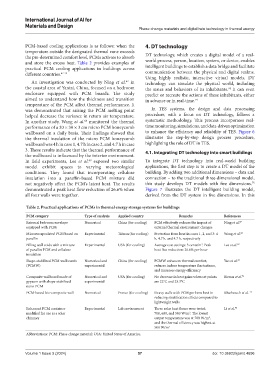
            and store the excess heat.  Table  2 provides examples of   world process, person, location, system, or device, enables
            practical PCM cooling applications in buildings across   intelligent buildings to establish a data bridge and facilitate
            different countries. 67-73                         communication between the physical and digital realms.
                                                               Using highly realistic, interactive virtual models, DT
              An investigation was conducted by Ning  et al.  in   technology can  simulate the  physical world,  including
                                                       67
            the coastal area of Yantai, China, focused on a bedroom   the states and behaviors of its inhabitants.  It can even
                                                                                                  74
            enclosure  equipped with PCM  boards.  The study   predict or recreate the actions of these inhabitants, either
            aimed to understand how the thickness and transition   in advance or in real-time. 74
            temperature of the PCM affect thermal performance. It
            was demonstrated that raising the PCM melting point   In TES systems, the design and data processing
            helped decrease the variance in return air temperature.   procedure, with a focus on DT technology, follows a
            In another study, Wang  et al.  monitored the thermal   systematic methodology. This process incorporates real-
                                     68
            performance of a 30 × 30 × 3 cm micro PCM honeycomb   time monitoring, simulations, and data-driven optimization
            wallboard on a daily basis. Their findings showed that   to enhance the efficiency and reliability of TES. Figure 6
            the  thermal  insulation  of  the  micro  PCM  honeycomb   illustrates the step-by-step design process procedure,
            wallboard was 4 h in case 1, 4.7 h in case 2, and 4.7 h in case   highlighting the role of DT in TES.
            3. These results indicate that the thermal performance of   4.1. Integrating DT technology into smart buildings
            the wallboard is influenced by the interior environment.
            In field experiments, Lee  et al.  exposed two similar   To integrate DT technology into real-world building
                                       69
            model exhibit spaces to varying meteorological     applications, the first step is to create a DT model of the
            conditions. They found that incorporating cellulose   building. By adding two additional dimensions – data and
            insulation into  a  paraffin-based  PCM  mixture  did   connection – to the traditional three-dimensional model,
            not negatively affect the PCM’s latent heat. The results   this study develops DT models with five dimensions.
                                                                                                            75
            demonstrated a peak heat flow reduction of 26.6% when   Figure  7 illustrates the DT intelligent building model,
            all four walls were together.                      derived  from  the  DT  system  in  five  dimensions.  In  this

            Table 2. Practical applications of PCMs in thermal energy storage systems for buildings

            PCM category             Type of analysis  Applied country       Remarks            References
            External bedroom envelope   Numerical  China (for cooling)  PCM effectively reduces the impact of   Ning et al. 67
            equipped with PCM                                      external thermal environment changes
            Microencapsulated PCM based on   Experimental  Taiwan (for cooling)  Protection from heat in cases 1, 2, and 3: 4   Wang et al. 68
            paraffin                                               h, 4.7 h, and 4.7 h, respectively
            Filling wall voids with a mixture   Experimental  USA (for cooling)  Average cost savings: 3 cents/m . Peak   Lee et al. 69
                                                                                       2
            of paraffin PCM and cellulose                          heat flux reduction: 26.6% per hour
            insulation
            Shape-stabilized PCM wallboards   Numerical and   China (for cooling)  PCMW enhances thermal comfort,   Yao et al. 70
            (PCMW)                   experimental                  reduces indoor temperature fluctuations,
                                                                   and increases energy efficiency
            Composite wallboard made of   Numerical and   USA (for cooling)  No decrease in heat gains when set points   Biswas et al. 71
            gypsum with shape-stabilized   experimental            are 22°C and 23.3°C
            nano-PCM
            PCM-based bio-composite wall  Numerical  France (for cooling)  Heavy walls with PCM perform best in   Kharbouch et al.  72
                                                                   reducing stratification effects compared to
                                                                   lightweight walls
            Enhanced PCM container   Experimental  Lab environment  Three solar heat fluxes were tested:   Li et al. 73
            modified for use as a solar                            700, 600, and 500 W/m . The lowest
                                                                                  2
            chimney                                                output temperature was at 700 W/m ,
                                                                                          2
                                                                   and the thermal efficiency was highest at
                                                                   500 W/m 2
            Abbreviations: PCM: Phase change material; USA: United States of America.


            Volume 1 Issue 3 (2024)                         57                             doi: 10.36922/ijamd.4696

