


Page 60 - IJAMD-1-3
P. 60
International Journal of AI for
            Materials and Design
                                                            Phase change materials and digital twin technology in thermal energy


               T pc        T 2
            Q =  ∫ C solid  + ∆+  ∫ C liquid           (II)
                        h
                T 1        T pc
              where T pc is the temperature of the phase change, Δh is
            the latent heat of fusion, and C solid and C liquid are the specific
            heat capacities of the PCM in the solid and liquid phases,
            respectively.
              A PCM is utilized in LHS systems, with the temperature
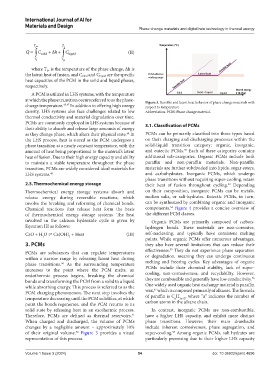
            at which the phase transition occurs referred to as the phase-  Figure 3. Sensible and latent heat behavior of phase change materials with
            change temperature. 45,47  In addition to offering high energy   respect to temperature
            density, LHS systems also face challenges related to low   Abbreviation: PCM: Phase change material.
            thermal conductivity and material degradation over time.
            PCMs are commonly employed in LHS systems because of   3.1. Classification of PCMs
            their ability to absorb and release large amounts of energy
                                                       48
            as they change phase, which alters their physical state.  In   PCMs can be primarily classified into three types based
            the LHS process, heat is stored as the PCM undergoes a   on their charging and discharging processes within the
            phase transition at a nearly constant temperature, with the   solid-liquid transition category: organic, inorganic,
                                                                               50
            amount of heat being proportional to the material’s latent   and eutectic PCMs.  Each of these categories contains
            heat of fusion. Due to their high energy capacity and ability   additional sub-categories. Organic PCMs include both
            to maintain a stable temperature throughout the  phase   paraffin and non-paraffin materials. Non-paraffin
            transition, PCMs are widely considered ideal materials for   materials are further subdivided into lipids, sugar esters,
            LHS systems. 49                                    and carbohydrates. Inorganic PCMs, which undergo
                                                               phase transitions without requiring super-cooling, retain
            2.3. Thermochemical energy storage                 their heat of fusion throughout cycling.  Depending
                                                                                                  53
            Thermochemical  energy  storage  systems  absorb  and   on their composition, inorganic PCMs can be metals,
            release energy during reversible reactions, which   molten salts, or salt-hydrates. Eutectic PCMs, in turn,
            involve the breaking and reforming of chemical bonds.   can be synthesized by combining organic and inorganic
                                                                         54
            Chemical  reactions  that  release  heat  form  the  basis   components.   Figure  4  provides a concise overview of
            of thermochemical energy storage systems. The heat   the different PCM classes.
            involved in the calcium hydroxide cycle is given by   Organic PCMs are primarily composed of carbon-
            Equation III as follows:                           hydrogen bonds. These materials are non-corrosive,
            CaO + H O ⇌ Ca(OH)  + Heat                 (III)   self-nucleating,  and  typically  have  consistent  melting
                   2          2
                                                               points. While organic PCMs offer numerous advantages,
            3. PCMs                                            they also have several limitations that can reduce their
                                                                         55
            PCMs are substances that can regulate temperatures   effectiveness.   They  do  not  experience  phase  separation
            within a narrow range by releasing latent heat during   or degradation, meaning they can undergo continuous
            phase transitions.  As the surrounding temperature   melting and freezing cycles. Key advantages of organic
                           50
            increases to the point where the PCM melts, an     PCMs include their chemical stability, lack of super-
            endothermic  process  begins,  breaking  the  chemical   cooling, non-corrosiveness, and recyclability. However,
                                                                                                            56
            bonds and transforming the PCM from a solid to a liquid   they are combustible and generally have low conductivity.
            while absorbing energy. This process is referred to as the   One widely used organic heat exchange material is paraffin
                                                                  57
            PCM charging phenomenon. The next step involves the   wax,  which is composed primarily of alkanes. The formula
            temperature decreasing until the PCM solidifies, at which   of paraffin is C H 2n+2 , where “n” indicates the number of
                                                                           n
            point the bonds regenerate, and the PCM returns to its   carbon atoms in the alkane chain.
            solid state by releasing heat in an exothermic process.   In contrast, inorganic PCMs are non-combustible,
            Therefore, PCMs are defined as thermal reservoirs.    have a higher LHS capacity, and exhibit more distinct
                                                         51
            When charged and discharged, the volume of PCMs    phase  transitions.  However,  their  main  drawbacks
            changes by a negligible amount – approximately 10%   include  inherent  corrosiveness,  phase  segregation,  and
            of their original volume.   Figure  3 provides a visual   super-cooling.  Among organic PCMs, salt hydrates are
                                                                          58
                                 52
            representation of this process.                    particularly promising due to their higher LHS capacity
            Volume 1 Issue 3 (2024)                         54                             doi: 10.36922/ijamd.4696

