


Page 32 - IJB-2-2
P. 32
Bioprinting in cardiovascular tissue engineering: a review

            ing heart and has the largest potential in regenerative   2. Conventional Engineering of Cardiac Tissues
                    [7]
            medicine .
               A  potential medical  solution  is through injecting   2.1 Design Considerations
            cells at infarct site or via intracoronary route [8–11] .   There are several factors to consider when designing
            Clinical trials have been performed to show safety and   and engineering cardiac tissue. Firstly, the engineered
            feasibility of using cells as therapy. Cardiosphere-der-  cardiac tissue physiological properties should be sim-
            ived cells (CDC), cardiac stem cells and bone marrow   ilar or close to human myocardium [21–22] . Specifically,
            cells have been  injected to repair and regenerate the   their modulus should  be between 0.2 to  0.5  MPa  at
            myocardium since stem/progenitor cells are capable of   end  diastole with tensile  strength  of 3–15 kPa, con-
                                                                                          2
            regeneration and differentiation [8–10] . For instance, car-  tractile pressure of 2–4 mN/mm  and electrical propa-
            diac stem cell can differentiate into myocyte, smooth   gation velocity of 25 cm/s.
            muscle cell and endothelial cell lineages with potential   Secondly, the  engineered  cardiac  tissue should be
                                 12
            of dividing into 4.2×10   cells [12] .  Increasing viable   compatible with the native in the aspect of heteroge-
            myocardium  mass and promoting  angiogenesis thro-  neous cell  population comprising  of cardiomyocytes
            ugh paracrine effects have been postulated as the suc-  and non-cardiomyocytes [23] . Cardiomyocytes forms
            cess factor in cell injection therapy [13,14] . However,   the minority of cell population in heart yet give rise to
            injecting cells directly has limitations such as low cell   the bulk volume of the heart; while fibroblast domi-
            survivability  and low cell retention at injured site.   nates the non-cardiomyocyte population and is in direct
            Hence, fabricating a patch-like or scaffold as a vehicle   contact with cardiomyocytes [23] . Other non-cardiomy-
            for delivering cells is a potential solution to improve   ocytes population includes endothelial  cells,  adipo-
            cell retention and survivability at infarct site.   cytes and neurons. The benefits of cardiomyocytes and
               The concept of creating engineered tissue from cells,   non-cardiomyocytes coupling include improvement in
            biomaterials and biological molecules forms the fun-  electrophysiology of  engineered cardiac tissue  and
            damental of tissue engineering [15] . Tissue engineering   production  of survival and trophic signals to cardi-
                                                                        [24,25]
            is a field which applies the principles of engineering   omyocytes  .
            and life sciences to develop biological substitutes that   Thirdly, the architectural features of native heart are
            can restore,  maintain or  improve tissue function [16] .   different  at various hierarchical  levels.  At the mil-
            Specifically, cardiac tissue  engineering aims  to pro-  li-scale level, aligned myofibers are induced by matrix
            vide biological solutions to restore failing hearts and   anisotropy while across the transmural direction, va-
                                                                                                          [26]
            has one of the largest potential in regenerative  med-  rying  spatial arrangement of  myofibers is  present  .
            icine [17] .                                       In the micro-scale, vascularization is needed as sup-
               With advancement of three-dimensional (3D) prin-  port system for nutrient/waste exchange in highly den-
                                                                                   [27]
            ting, also  known as additive manufacturing, various   sed native myocardium  . The design considerations
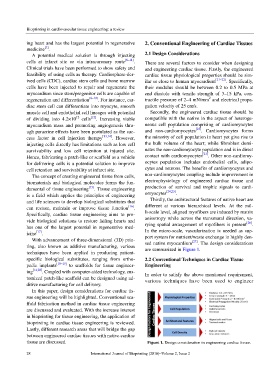
            techniques have been  applied  in  producing  patient-   are summarized in Figure 1.
            specific biological substitutes, ranging  from ortho-  2.2 Conventional Techniques in Cardiac Tissue
            pedic implants [18–19]   to scaffolds for tissue engineer-  Engineering
            ing [14,20] . Coupled with computer-aided technology, cus-  In order to satisfy the above mentioned requirement,
            tomized patch-like scaffold can be designed using ad-  various techniques have  been used to engineer
            ditive manufacturing for cell delivery.
               In this paper, design considerations for cardiac tis-
            sue engineering will be highlighted. Conventional sca-
            ffold fabrication method in cardiac tissue engineering
            are discussed and evaluated. With the increase interest
            in bioprinting for tissue engineering, the application of
            bioprinting in cardiac tissue engineering is reviewed.
            Lastly, different research areas that will bridge the gap
            between engineered cardiac tissues with native cardiac

            tissue are discussed.                               Figure 1. Design consideration in engineering cardiac tissue.
            28                          International Journal of Bioprinting (2016)–Volume 2, Issue 2

